Spaces that wrap spaces
The capability spine decided who may reach a resource. This chapter is about what happens to a request on the way — the governors that make a resource resilient and bounded: rate limits, retries, circuit breakers, failover, timeouts, and concurrency caps. In ikigai these are not features baked into each endpoint. They are overlays: a space wraps another space and changes how requests pass through it, and because a space can wrap a space, they stack.
This builds directly on dynamic spaces from The ikigai Book. An overlay is a space whose job is not to answer but to govern the space it wraps, so a wrapped resource answers exactly as before until a governor has something to say — at which point what it says is a refusal.
   request
     │
     ▼
  ┌──────────────────────────────────────────────────┐
  │ Retry (idempotent verbs, spends a budget)        │
  │  ┌─────────────────────────────────────────────┐ │
  │  │ CircuitBreaker (open / closed / half-open)  │ │
  │  │  ┌────────────────────────────────────────┐ │ │
  │  │  │ Timeout (a deadline on the call)       │ │ │
  │  │  │  ┌───────────────────────────────────┐ │ │ │
  │  │  │  │  the space being guarded          │ │ │ │
  │  │  │  │  (a door, a mount, an endpoint)   │ │ │ │
  │  │  │  └───────────────────────────────────┘ │ │ │
  │  │  └────────────────────────────────────────┘ │ │
  │  └─────────────────────────────────────────────┘ │
  └──────────────────────────────────────────────────┘
The three facts every overlay reads
The overlays share a vocabulary. Each one makes its decision from the same three facts about a request, and no more:
- Is the verb idempotent? A Source or an Exists can be safely re-issued; a Sink that is not idempotent cannot. Retry and Failover refuse to re-run what is unsafe to re-run.
- What class is the failure? A failure is transient (worth another try or a different target)
or permanent (do not bother). A
429-style “try again after” carries its own delay. - What is left of the retry budget? A single counter shared across the whole resolution tree.
That third fact is the one security hook in the resilience family, and it is worth dwelling on. Nested retries multiply: a Retry wrapping a space that itself wraps a Retry could turn one request into many. A shared retry budget caps the total number of re-issues across the entire tree, so no arrangement of nested governors can amplify one request into a storm. It is a blast-radius bound, expressed as authority — you hold a budget, and when it is spent, re-issues stop.
The two faces, overlay by overlay
Here is the split that makes this chapter part of the book rather than an appendix. Every governor has a security reading and a UX reading, and the verdict is which one it is primarily for:
| overlay | security face | UX face | primarily |
|---|---|---|---|
| RateLimit | abuse / denial-of-service control; politeness to a published rate | a “try again after” lets a client back off instead of hammering | both |
| Retry | only the shared budget, capping amplification | hides a transient blip; fewer visible failures | UX |
| CircuitBreaker | blast-radius containment: stop feeding a dead dependency; recover deliberately | fail fast instead of hanging the person on a dead backend | both |
| Failover | — (availability, not a security control) | continuity: move to a backup | UX |
| Timeout | a resource-exhaustion bound: a worker is never held forever | never hang; drive the loading / “did not answer” state | both |
| Throttle / Bulkhead | isolation: one tenant or hot prefix cannot starve the pool | backpressure — park the excess, never an error | both |
The pattern in the table is the pattern of the whole book. A refusal that protects the dependency or the host (RateLimit, CircuitBreaker, Timeout, Throttle) has a security face; a re-issue that protects the caller’s experience (Retry, Failover) is UX-facing, with the budget its only security hook. Same mechanism, read by what the refusal is for.
Transparency: a governor you can see through
One property makes all of this drawable, and it is worth naming because it is unusual. The overlays
are transparent to structure: a governor reports the topology, the identity, and the cache
identity of the space it wraps. So Retry(CircuitBreaker(Timeout(space))) still reports the doors
underneath it; the system’s own introspection sees through the stack to what is guarded. What a
governor adds is only ever a refusal — and the kernel never caches a refusal — so the arrangement
can be harvested from the topology while the governor’s state (a breaker open or closed, a
budget’s remaining count) is a separate thing drawn on top.
The governor as a constraint made explicit
Step back and the whole chain has one organizing idea, borrowed from the theory of constraints (Goldratt): a system’s throughput is set by its bottleneck, and the useful moves are to exploit the bottleneck, subordinate everything else to it, and make the constraint explicit and enforceable. The overlays are the governance half of that: a rate, a timeout, a concurrency cap is a constraint written down as a resource and enforced by the kernel, so “do not exceed this” stops being a hope in a code review and becomes a refusal at resolution. Non-conforming behavior simply fails to resolve. (The throughput half of the same idea — cache and golden thread as ways to exploit the constraint — is the next chapter.)
Drive the overlays yourself
The box diagram above is a picture. Below it runs: a resilience harness in this page, the
real ikigai-throttle governors wrapped around a stub dependency you control, so you can make
the dependency fail, stall or push back and watch what each governor does about it. Nothing is
mocked except the dependency. The breaker that trips here is the CircuitBreaker every ikigai
host runs, and the timeout is its Timeout.
The harness is a kernel of its own (crates/resilience-harness), started the first time you
press Run in a cell below that says “in the resilience harness”, or a button beside the
picture. It binds a handful of names:
urn:iki:tutorial:harness:mode, the one thing you write: what the stub does when called.okanswers;slowtakes 10 seconds, past the timeout’s budget;failfails transiently (unavailable);limitedasks to be called again after a second (retry after). Anything else is refused as an invalid argument.urn:iki:tutorial:harness:upstream, the stub itself, ungoverned. It numbers every call it receives, so an answer tells you whether a call reached it.urn:iki:tutorial:harness:call, the same stub behind the stack this chapter draws:Retry(CircuitBreaker(Timeout(upstream))).urn:iki:tutorial:harness:clock, the harness’s time. It moves only when you move it (Sink a duration such as5s) or when a governor waits.urn:iki:tutorial:harness:service, the same stub again, in a primary space, behind aFailoverwhose second space is a backup that always answers.urn:iki:tutorial:harness:work, the stub once more, behind aThrottlethat lets two calls run at once, andurn:iki:tutorial:harness:burst, which starts several calls to it at once (Sink a number such as5).urn:throttle:state, the governors’ state in words, andurn:diagram:state, the harness’s arrangement with that state drawn over it: the picture below.
The stack is built like this, innermost first:
/// The harness's root: the governed call, the stub's own space, the board, and the
/// diagram, in that order.
///
/// The stack is the one the chapter draws, innermost first: `Timeout` bounds each invocation
/// of the upstream, `CircuitBreaker` counts the transient failures that come out of it
/// (a timeout among them), and `Retry` re-issues what is worth re-issuing from the run's
/// budget. Only the breaker has state worth showing (`Retry` and `Timeout` hold nothing past
/// one call), so it is the one observed on the board.
pub fn root(
    state: &Arc<HarnessState>,
    clock: &Arc<HarnessClock>,
    board: &StateBoard,
    background: &Arc<Background>,
) -> Arc<dyn Space> {
    let timer = Arc::clone(&background.timer);
    let stub: Arc<dyn Endpoint> = Arc::new(upstream(Arc::clone(state), Arc::clone(&timer)));

    let governed = EndpointSpace::new()
        .bind_arc(Exact::new(CALL), Arc::clone(&stub))
        .named(space_iri("tutorial:harness:governed"));
    let timed = Timeout::new(governed, TIMEOUT).with_timer(timer.clone());
    let breaker = CircuitBreaker::new(timed, THRESHOLD, COOLDOWN)
        .with_clock(Arc::clone(clock) as _)
        .observed(board, GOVERNOR)
        .expect("one governor, named once");
    let retry = Retry::new(breaker, ATTEMPTS)
        .with_timer(timer.clone())
        .with_max_wait(MAX_WAIT);

    // Failover: the stub in a primary space, bounded by the same timeout, else the backup.
    let primary = EndpointSpace::new()
        .bind_arc(Exact::new(SERVICE), Arc::clone(&stub))
        .named(space_iri("tutorial:harness:primary"));
    let spare = EndpointSpace::new()
        .bind(Exact::new(SERVICE), backup())
        .named(space_iri("tutorial:harness:backup"));
    let failover = Failover::new(vec![
        Arc::new(Timeout::new(primary, TIMEOUT).with_timer(timer.clone())) as Arc<dyn Space>,
        Arc::new(spare),
    ])
    .observed(board, FAILOVER)
    .expect("one governor, named once");

    // The bulkhead: the stub again, at most SLOTS calls at once; the rest park.
    let pool = EndpointSpace::new()
        .bind_arc(Exact::new(WORK), Arc::clone(&stub))
        .named(space_iri("tutorial:harness:pool"));
    let bulkhead = Throttle::new(pool)
        .limit(WORK, SLOTS)
        .observed(board, BULKHEAD)
        .expect("one governor, named once");

    let own = EndpointSpace::new()
        .bind(Exact::new(MODE), mode(Arc::clone(state)))
        .bind(
            Exact::new(CLOCK),
            self::clock(Arc::clone(clock), Arc::clone(background)),
        )
        .bind_arc(Exact::new(UPSTREAM), stub)
        .bind(Exact::new(BURST), burst(Arc::clone(background)))
        .named(space_iri("tutorial:harness:upstream"));

    Arc::new(Fallback::new(vec![
        Arc::new(retry) as Arc<dyn Space>,
        Arc::new(failover),
        Arc::new(bulkhead),
        Arc::new(own),
        Arc::new(board.space().named(space_iri("tutorial:harness:board"))),
        Arc::new(ikigai_diagram::space()),
    ]))
}
with these settings: a call may run 2 seconds; the breaker trips after 3 consecutive transient
failures and stays open for 5 seconds; Retry waits out a retry after of at most 2 seconds;
and the kernel gives every run a retry budget of 2 re-issues in all, whatever Retry’s own
attempts would allow:
/// How long `Timeout` lets a call run.
pub const TIMEOUT: Duration = Duration::from_secs(2);
/// How long the upstream takes in `slow` mode: past the timeout's budget.
pub const SLOW: Duration = Duration::from_secs(10);
/// Consecutive transient failures that trip the breaker open.
pub const THRESHOLD: u32 = 3;
/// How long an open circuit refuses before it lets one call through as a probe.
pub const COOLDOWN: Duration = Duration::from_secs(5);
/// The most invocations `Retry` makes of one call: more than the budget allows, so the
/// budget is what stops it.
pub const ATTEMPTS: u32 = 5;
/// The longest `RetryAfter` delay `Retry` waits out; a longer one is returned unchanged.
pub const MAX_WAIT: Duration = Duration::from_secs(2);
/// The delay the upstream asks for in `limited` mode.
pub const LIMITED_DELAY: Duration = Duration::from_secs(1);
/// Re-issues one run may spend in all, across every overlay: the run's retry budget.
pub const RETRY_BUDGET: u32 = 2;
/// How many calls to [`WORK`] the bulkhead lets run at once; the rest park.
pub const SLOTS: usize = 2;
/// The most calls one burst may start.
pub const MAX_BURST: usize = 10;
Why the harness has its own clock. A breaker’s cooldown, a timeout’s budget and a retry’s wait are all time, and on the wall clock this page would answer differently for every reader and for every run of the test that replays it. So the harness clock moves only when you say (“wait 5 seconds”) or when a governor waits, and a governor’s wait is virtual: the earliest wait pending finishes first and moves the clock to its deadline, in no real time. A timeout racing a 10-second call against its 2-second budget fires at 2 seconds, exactly, on every page, and the call it abandoned never finishes. That makes every answer below the same for you as for the chapter.
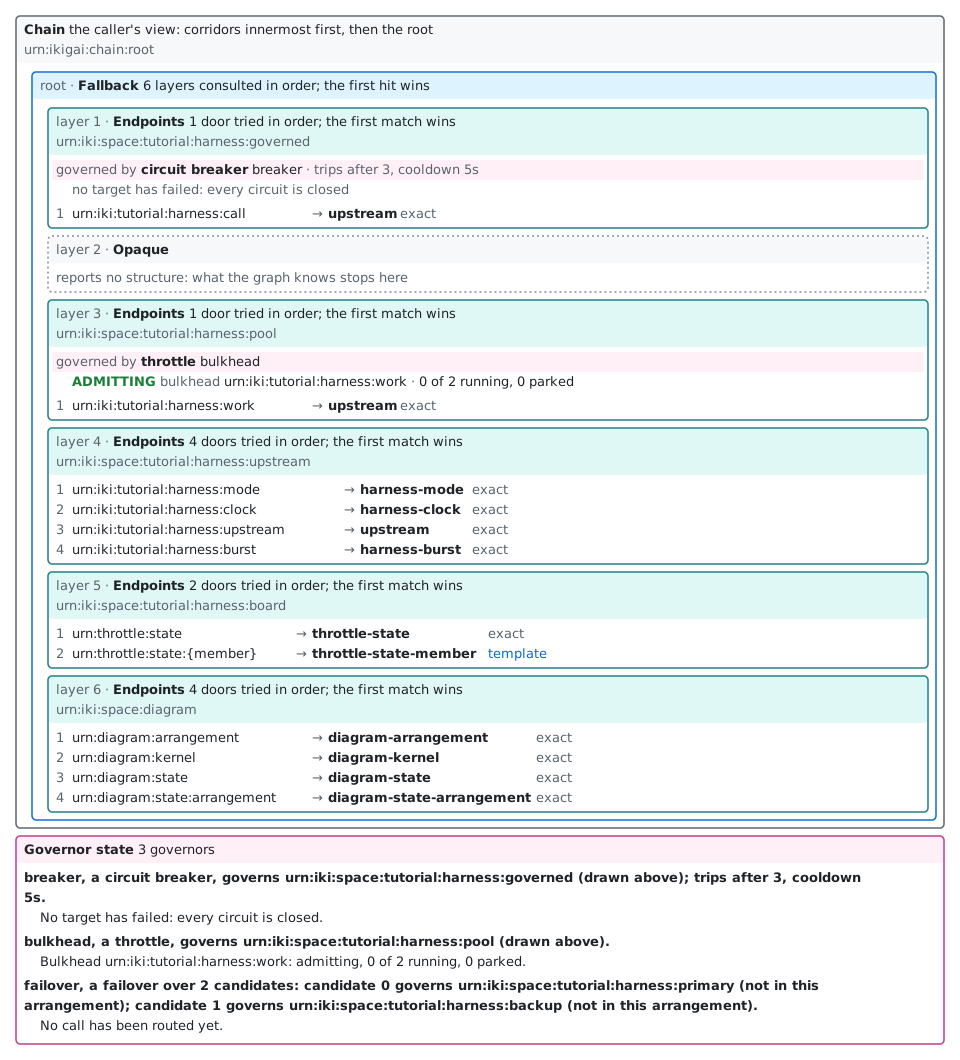
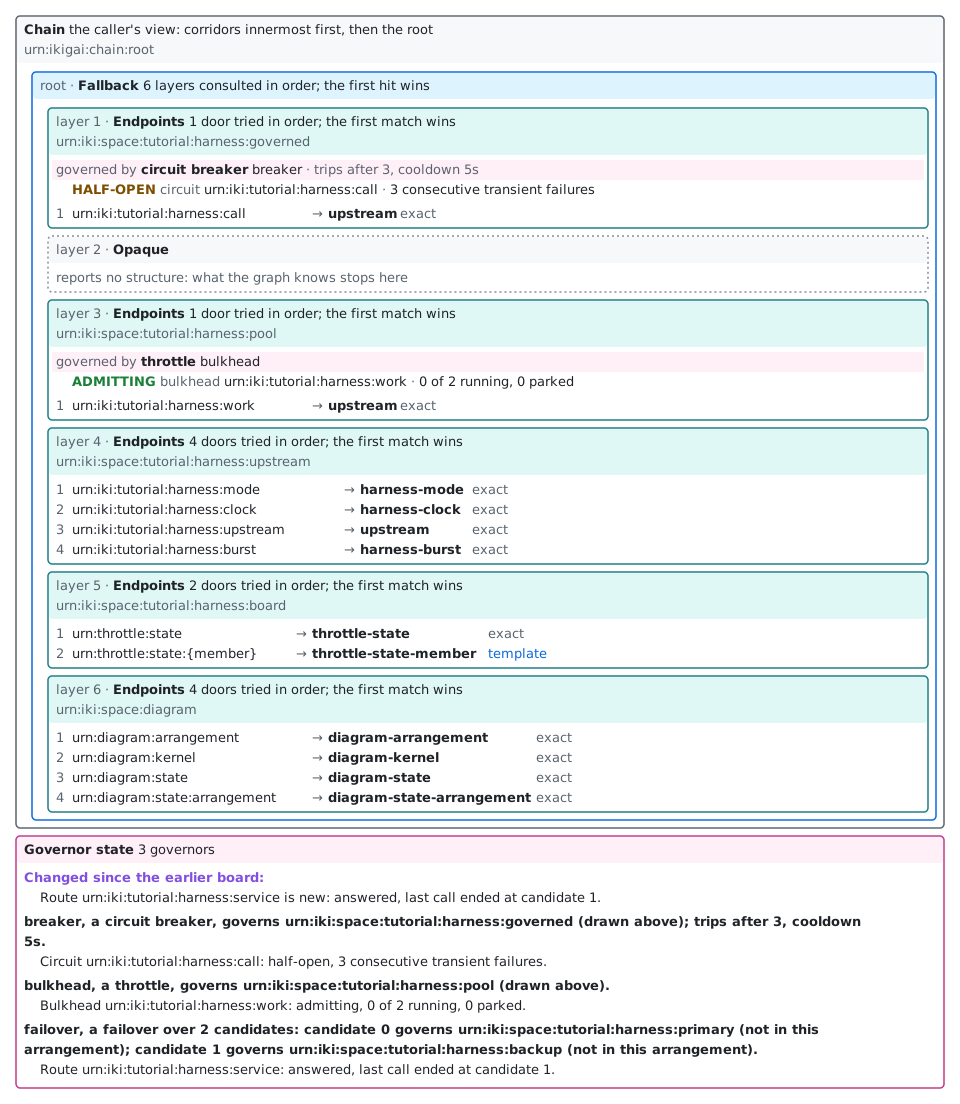
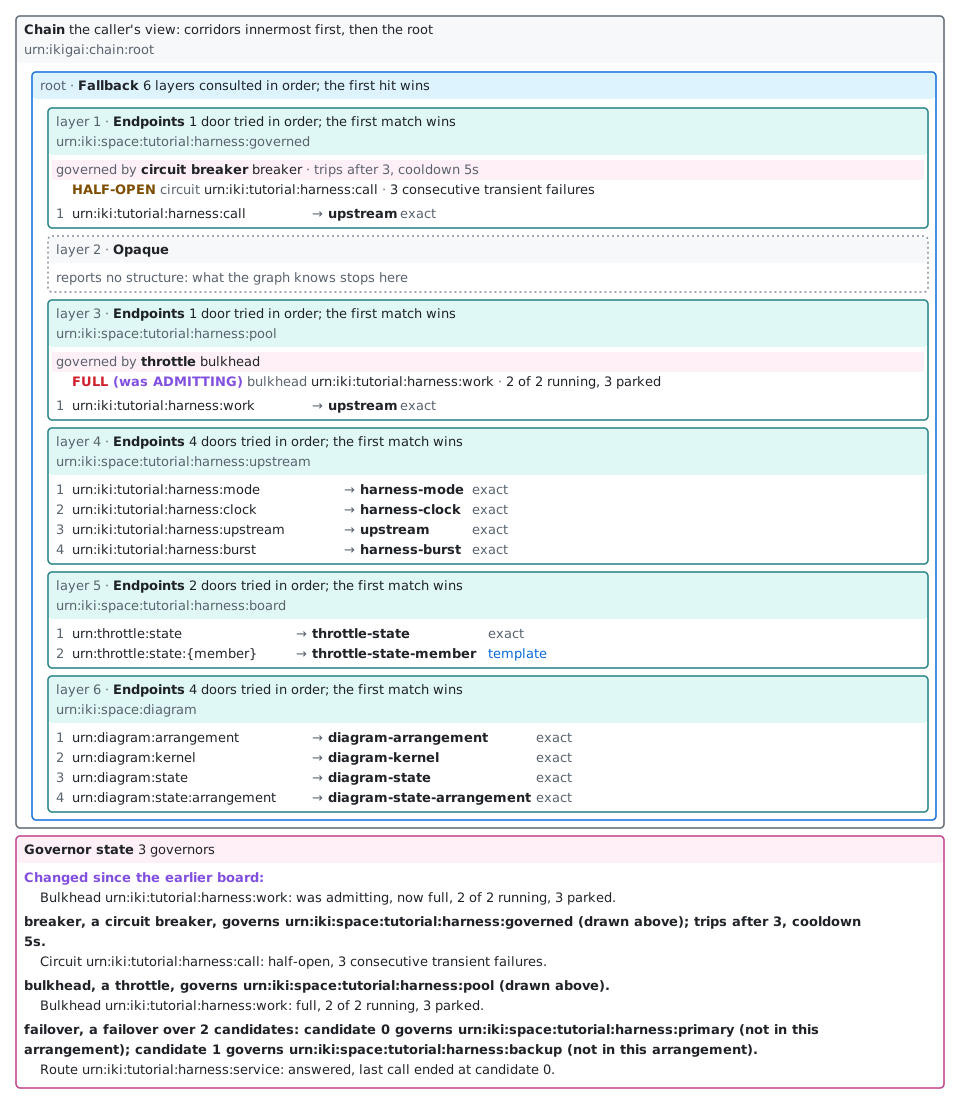
What the picture draws, and what it cannot. The circuit breaker and the bulkhead appear in
the picture as governors, each in the box of the space it governs. That is the transparency
property above at work: Retry and Timeout hold nothing past a single call (an attempt count,
a deadline), so they have no state to draw, and they report the topology of the space they
wrap, so the picture sees through them to the door they govern. Failover is the exception: it
encloses two spaces and picks the one that answers only when it is called, and no kind of space
says that, so it reports no structure at all, and the picture draws it as an opaque box. Its
state, which space the last call ended at, is said in words below the picture with everyone
else’s.
The walkthrough, in stages
The walkthrough below is a sequence of stages. A stage is the harness after a step that changed its picture, and each one is a numbered tab. Below the tabs, two pictures sit side by side (stacked on a phone): After is the open tab’s stage, and Before is the stage you compare it with, the one just before unless you pick another from the “Compare with” list above them. Under them is what changed from Before to After, in words (the board’s words, compared line by line: the words that differ are marked, and the line they replaced is said beside them). Below that is the tab’s step: a sentence or two and the cells you run.
Each picture says whose it is. Until you run a tab’s step, its picture is the chapter’s own, in a
dashed frame; run it, and After becomes the picture your page drew, in a solid frame. Run the tabs
in order: each step starts where the one before left the harness. A step that
changes nothing the picture shows makes no stage, and the picture says “no change” instead. Twelve
stages: the breaker from every circuit closed to a circuit half-open again, then the failover
moving to its backup and back, then the bulkhead filling and draining. (The tabs are the books’
stages viewer, js/stages.js, which knows nothing about governors: the page names the line that
draws the picture and the line that says it in words, and the viewer does the rest.)
Watch the governors, not the upstream. The picture draws the governors, not the stub they
govern. Setting the stub’s mode changes nothing in the picture: a governor learns of a mode only
when a call goes through it. The line above the tabs keeps the facts that change current, each
read from the name that holds it after every step: the upstream’s mode
(urn:iki:tutorial:harness:mode), the circuit (urn:throttle:state:breaker), the failover’s
route (urn:throttle:state:failover), the bulkhead (urn:throttle:state:bulkhead) and the
harness time (urn:iki:tutorial:harness:clock).
The picture marks what changed. After every step the page also reads the board as Turtle
(urn:throttle:state as=text/turtle) and hands it to the next read of the picture as
before= (ikigai-diagram 0.2.4): each key that changed since is marked in the picture, after
its state word (OPEN (was CLOSED), (new)), and the words in the picture begin with what
changed. The chapter’s pictures are marked against the stage before; the first stage you make
yourself is not marked, because the page reads nothing until you take a step.
The buttons are yours. They drive the same harness the cells do. A press that changes the picture adds a stage after the chapter’s, numbered on, and opens it as After, beside the stage the harness was at before the press, so you can compare any two states the harness has been in.
Every picture is drawn once. A stage’s picture is urn:diagram:state, a pure composition of
two resources: the harness’s topology and the governors’ board. It is cacheable, and it hangs from
what it read: the board hangs from the breaker’s golden thread, urn:throttle:governor:breaker,
which the breaker cuts on every change its board shows (a failure counted, a circuit tripped or
closed). A cooldown running out cuts nothing; the board’s answer is cached only until it would run
out, on the harness clock. So a picture stays true until the state moves. After every step the
page asks for it as your own lines would: a step that moved a governor cut its thread, so the
picture is drawn again, once; a step that changes nothing cuts nothing, so the page’s read is a
cache hit, and the page says so (stage 4 shows one in a trace). Switching tabs, or what you
compare with, asks for nothing at all: each tab keeps the picture its step drew. The chapter’s twelve pictures are files the same
harness drew natively, held to it byte for byte by a test, so they show before the page’s kernel
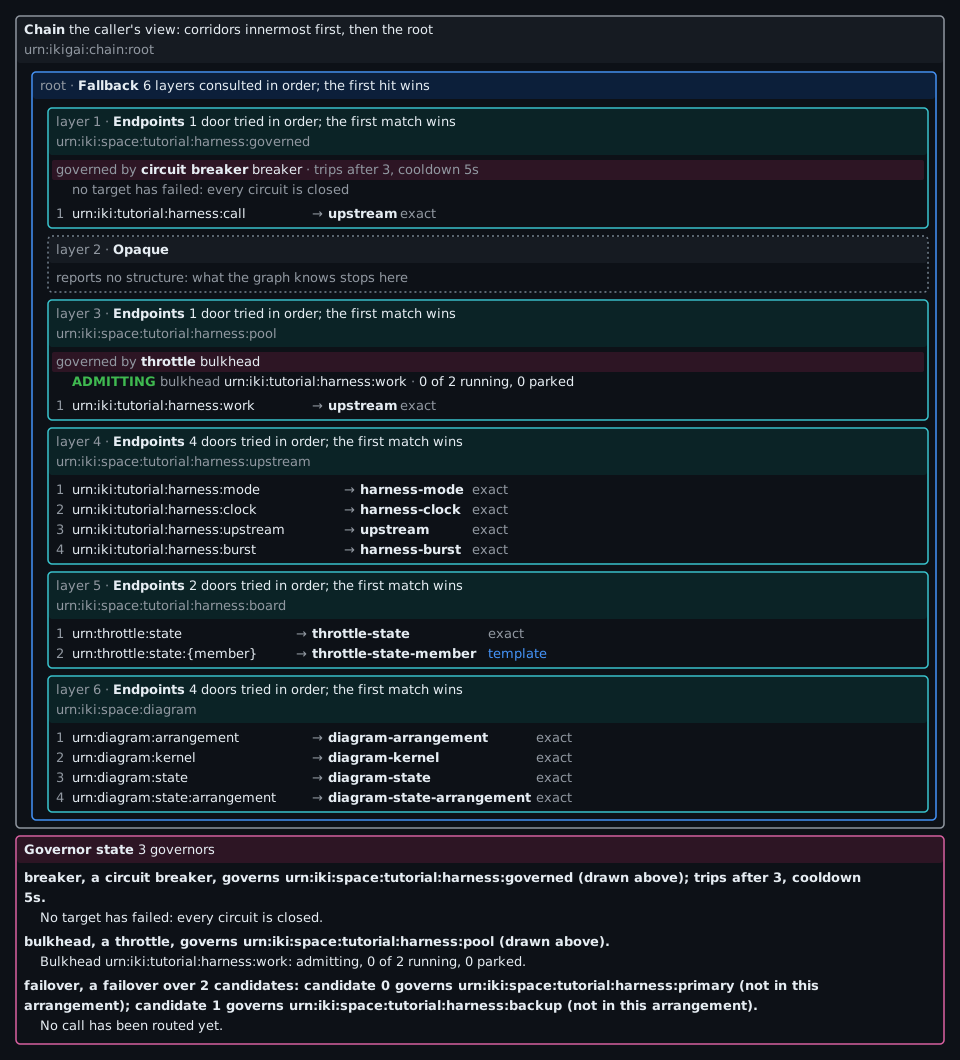
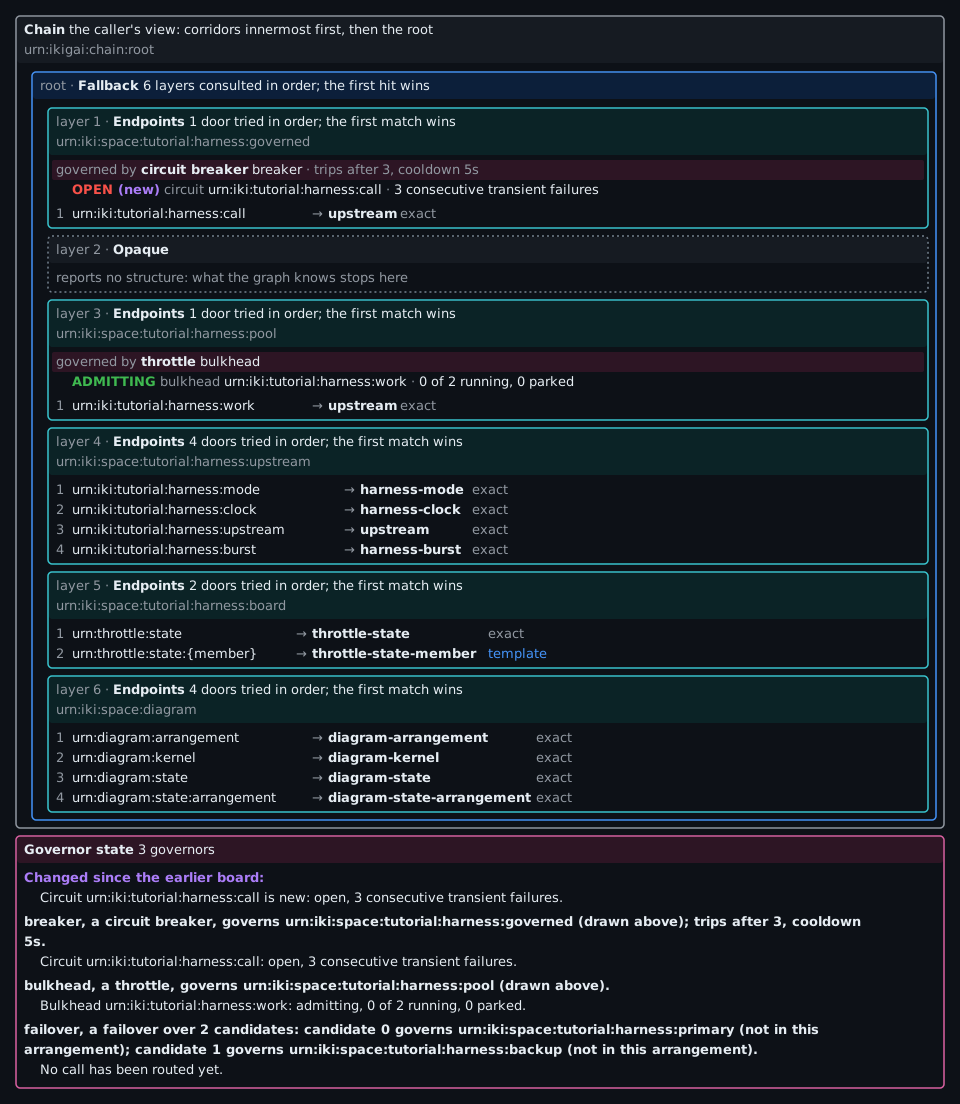
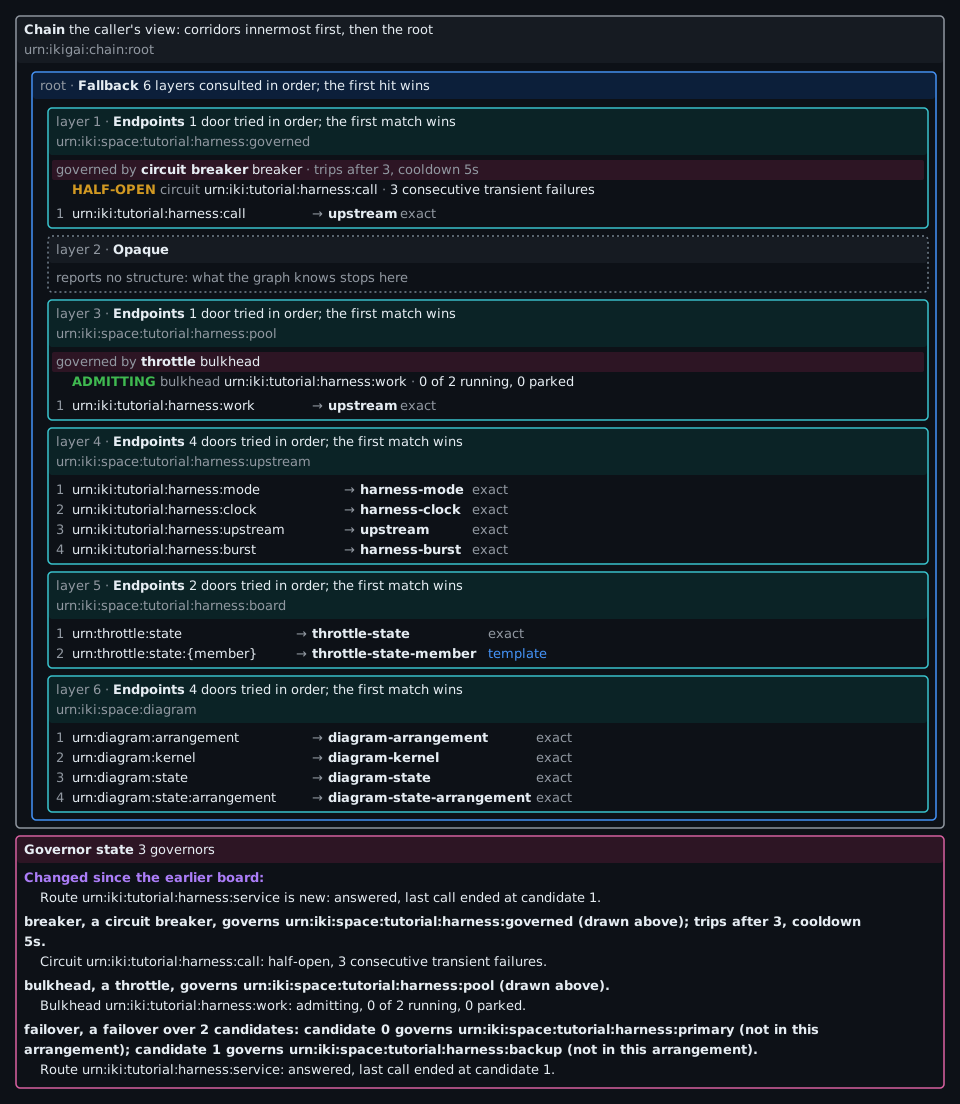
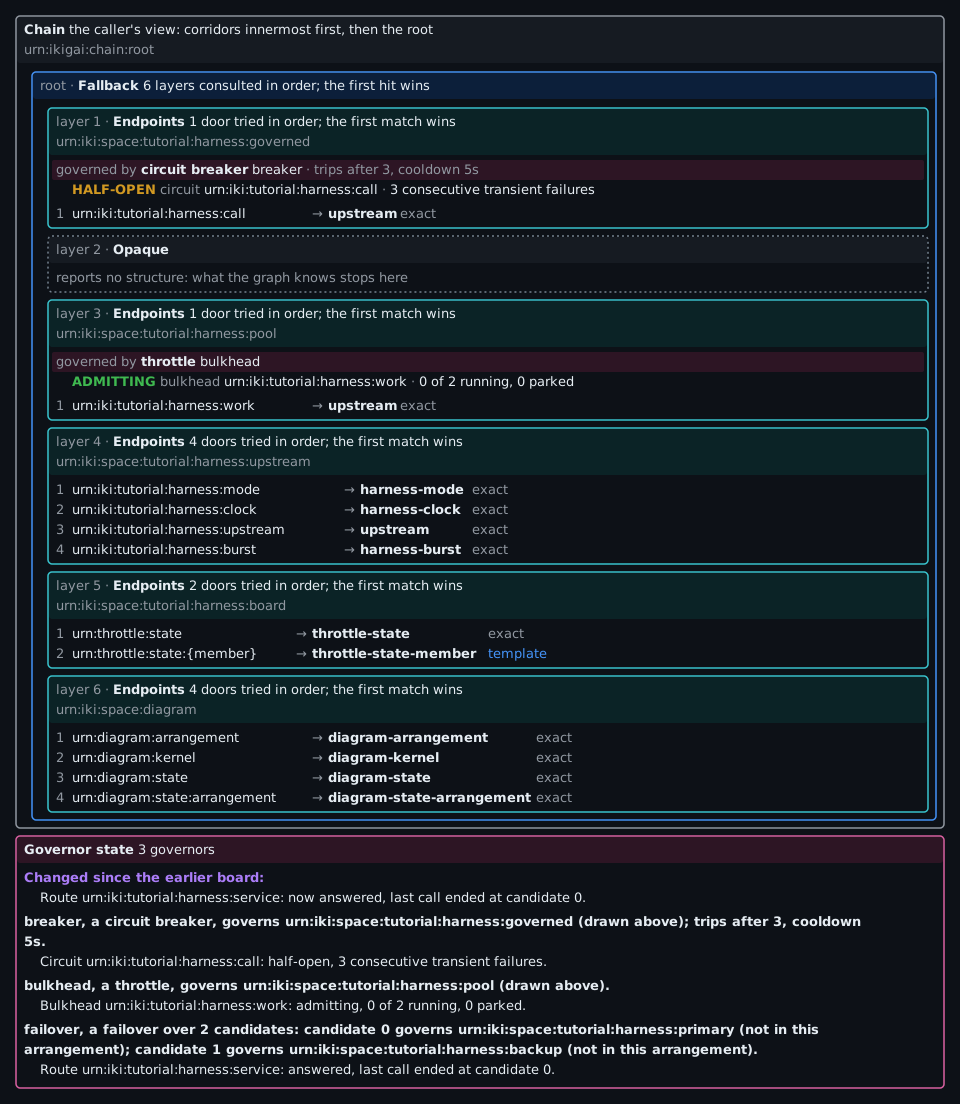
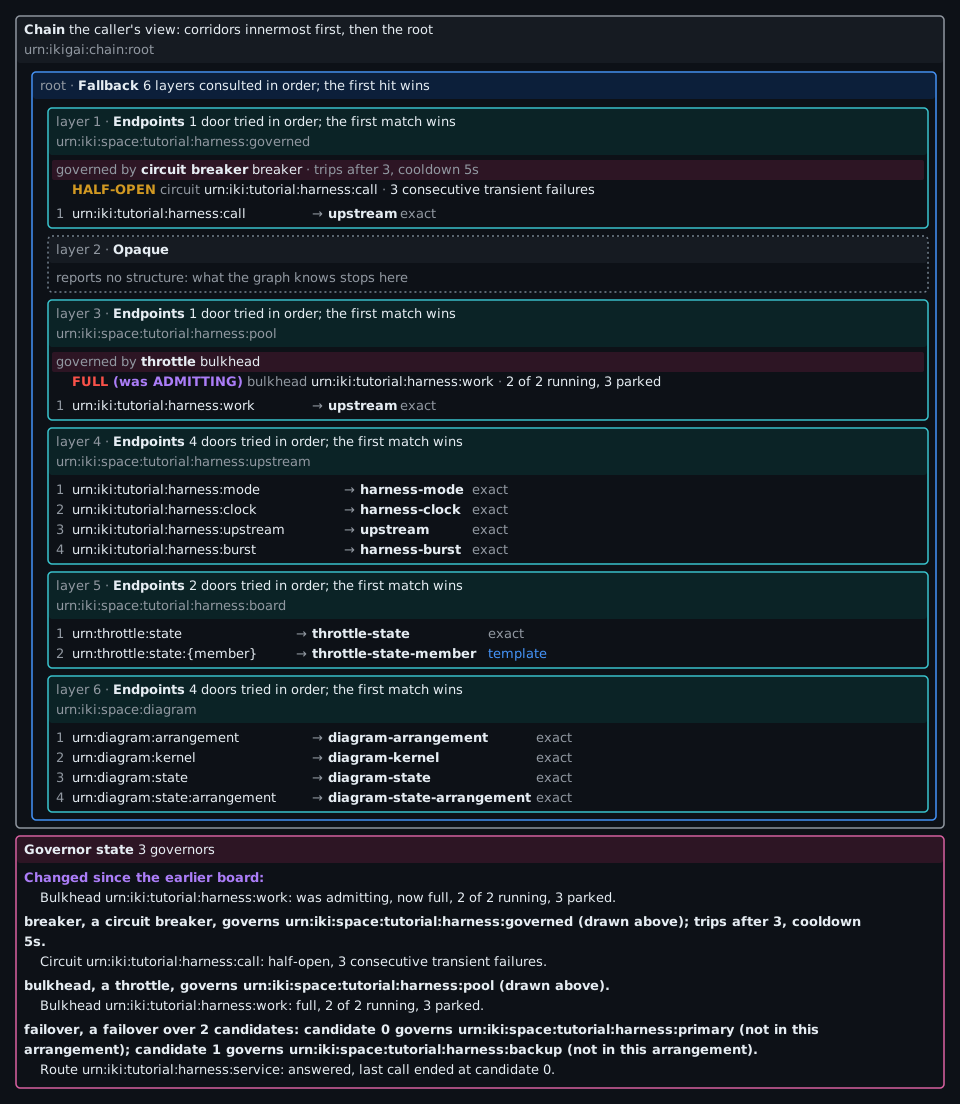
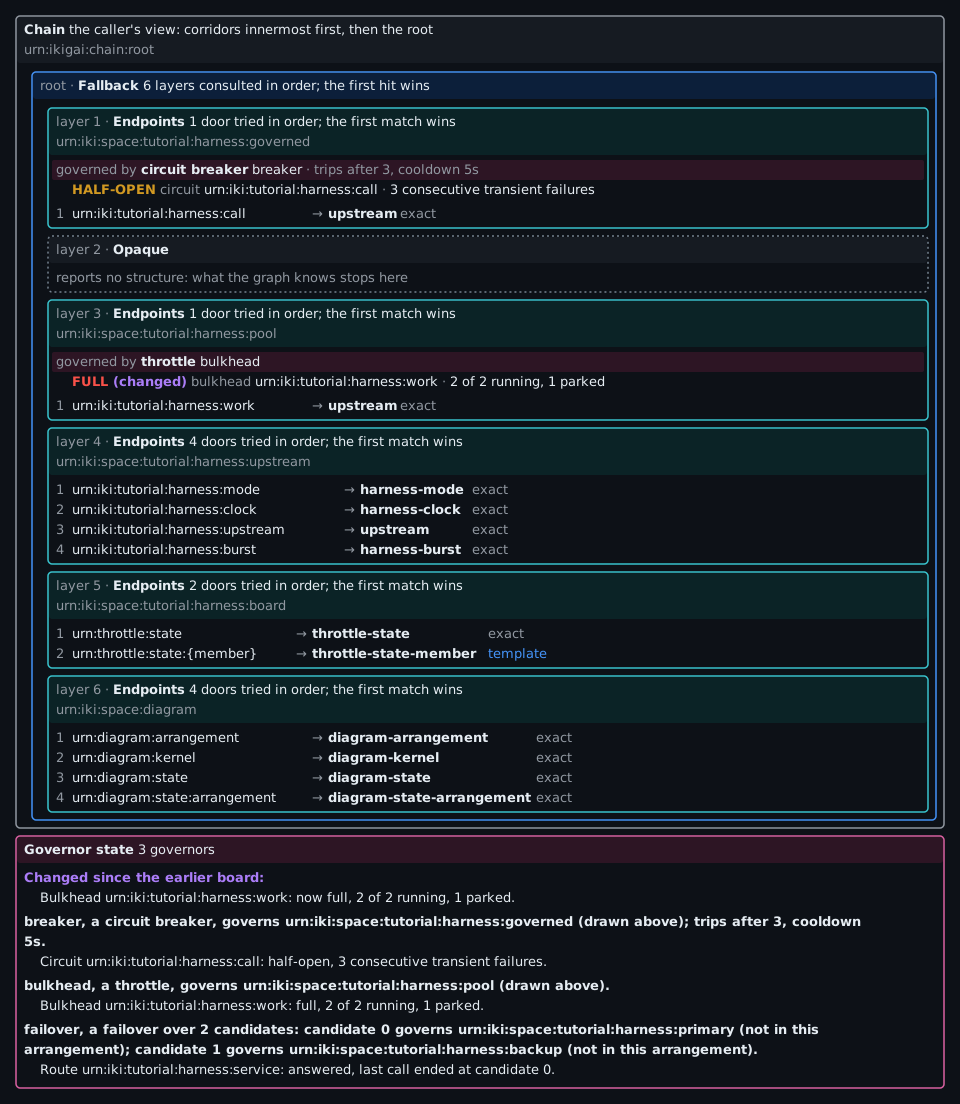
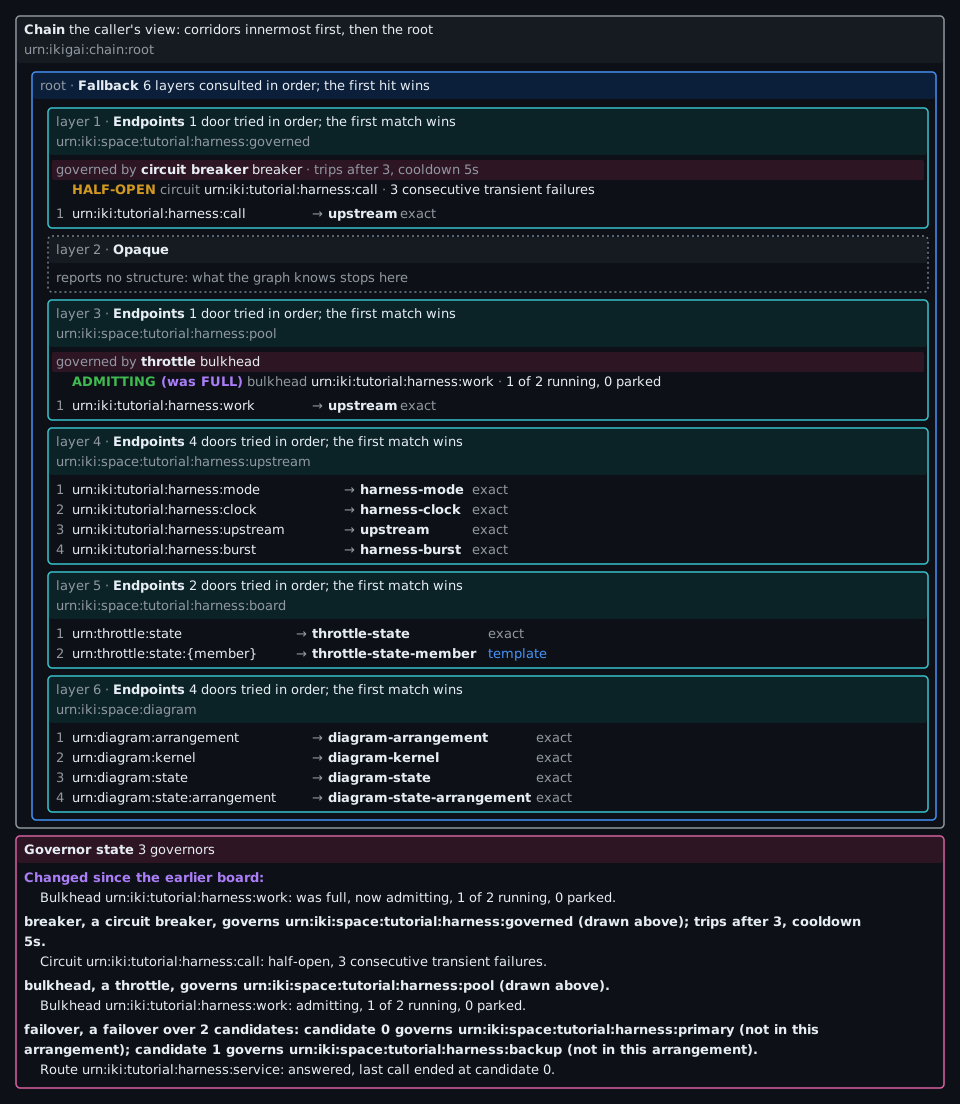
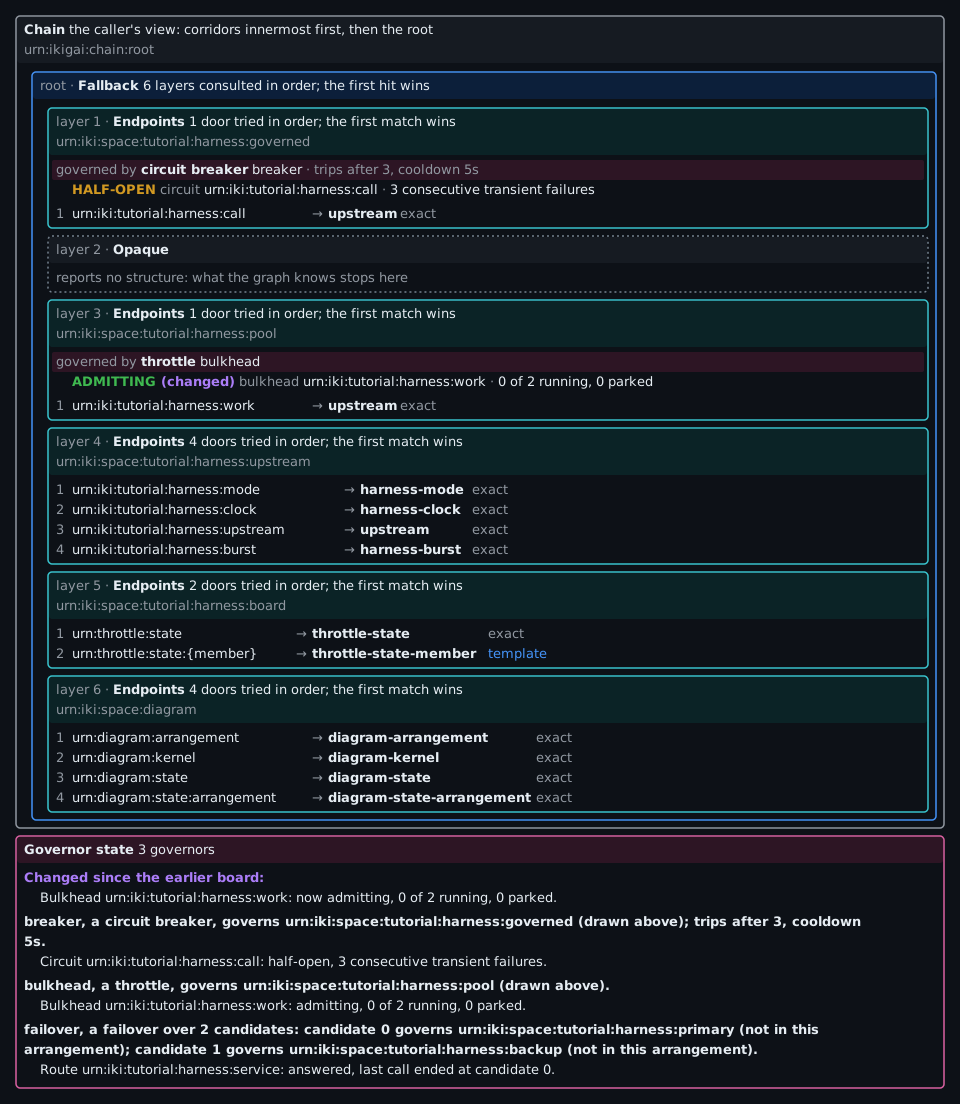
loads, without it, and in print. Every picture is kept in both the light and the dark colors
(scheme=light, scheme=dark), and the page shows the one the book’s theme needs.
- Set the upstream to ok
- Set the upstream to slow
- Set the upstream to fail
- Set the upstream to limited
- Call once
- Call ten times
- Call the service
- Start five calls at once
- Wait 5 seconds
- Wait 10 seconds
- upstream: ok
- no circuit has failed yet
- no call has gone through the failover yet
- bulkhead `urn:iki:tutorial:harness:work`: 0 of 2 running, 0 parked
- the harness clock reads 0s
Stage 1: the start
The harness as it starts. No call has been made, so no circuit has failed, and the breaker holds nothing but its settings.
The cells in the stages assume you run them in order on a fresh page. If you have pressed the buttons first, the cells answer from where you left the harness and say they differ from the chapter, and a cell that then changes something adds a stage of yours. Reloading the page starts the harness over.
upstream: ok · no circuit has failed yet · no call has gone through the failover yet · bulkhead `urn:iki:tutorial:harness:work`: 0 of 2 running, 0 parked · the harness clock reads 0s
throttle state: 3 governors visible
breaker: circuit-breaker, governs urn:iki:space:tutorial:harness:governed, trips after 3, cooldown 5s
bulkhead: throttle, governs urn:iki:space:tutorial:harness:pool
  bulkhead `urn:iki:tutorial:harness:work`: 0 of 2 running, 0 parked
failover: failover over 2 spaces
  candidate 0: governs urn:iki:space:tutorial:harness:primary
  candidate 1: governs urn:iki:space:tutorial:harness:backup
Stage 2: the breaker trips
Set the stub failing. This changes nothing in the picture: the mode is the stub’s.
the upstream is now fail
[uncacheable]
Make one governed call. It fails, but look at the call number:
error: unavailable: upstream failed (call 3)
One call from you was three calls to the stub. unavailable is transient, so Retry re-issued
it, twice, until the run’s budget of 2 re-issues was spent; and the breaker below it counted
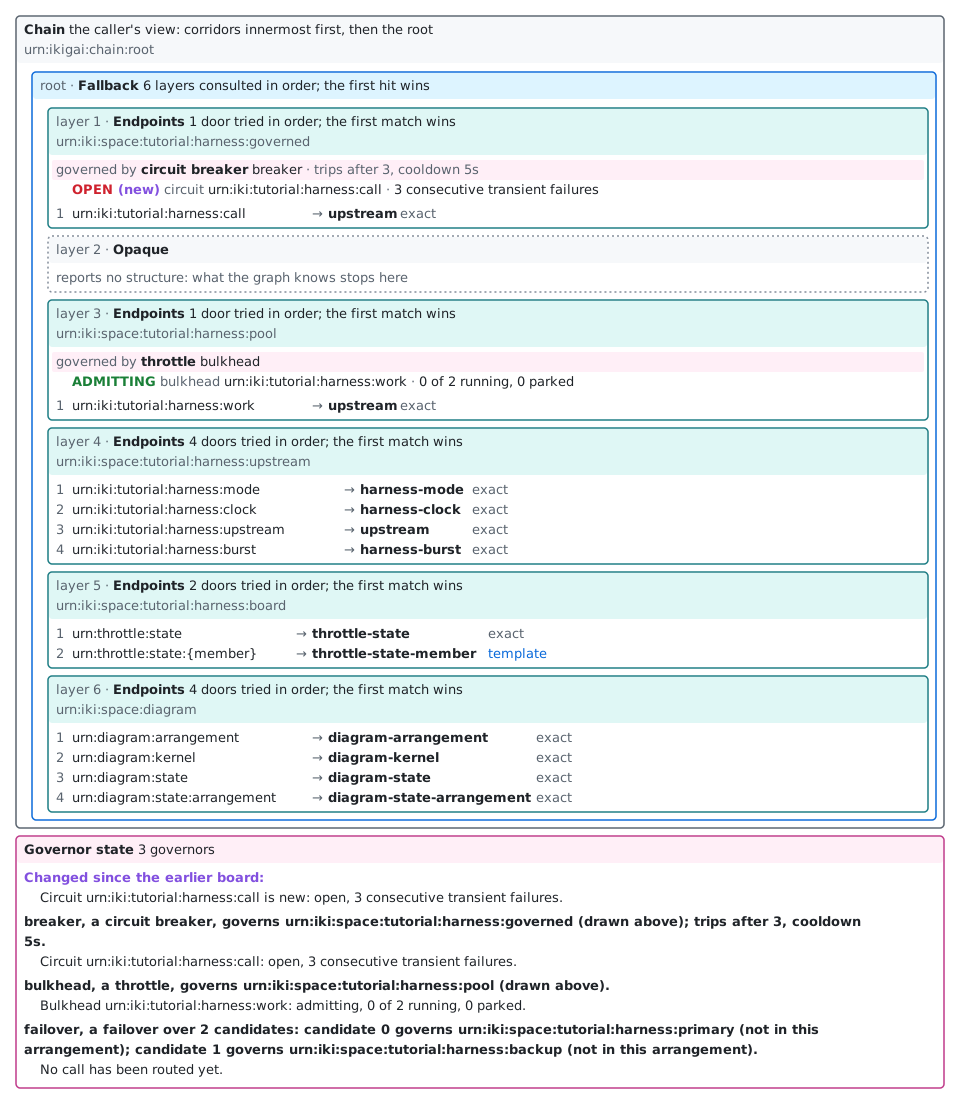
every one of the three failures. Three is its threshold, so the circuit is now open:
upstream: fail · circuit `urn:iki:tutorial:harness:call`: open, 3 consecutive transient failures · no call has gone through the failover yet · bulkhead `urn:iki:tutorial:harness:work`: 0 of 2 running, 0 parked · the harness clock reads 0s
throttle state: 3 governors visible
breaker: circuit-breaker, governs urn:iki:space:tutorial:harness:governed, trips after 3, cooldown 5s
  circuit `urn:iki:tutorial:harness:call`: open, 3 consecutive transient failures
bulkhead: throttle, governs urn:iki:space:tutorial:harness:pool
  bulkhead `urn:iki:tutorial:harness:work`: 0 of 2 running, 0 parked
failover: failover over 2 spaces
  candidate 0: governs urn:iki:space:tutorial:harness:primary
  candidate 1: governs urn:iki:space:tutorial:harness:backup
The board says so, in words (served from the cache: the line above the tabs read the breaker’s key after the call, and nothing has cut it since):
breaker: circuit-breaker, governs urn:iki:space:tutorial:harness:governed, trips after 3, cooldown 5s
  circuit `urn:iki:tutorial:harness:call`: open, 3 consecutive transient failures
[cached]
Call again:
error: retry after 5000 ms: circuit open for `urn:iki:tutorial:harness:call`
No call number: this one never reached the stub. An open circuit fails fast, and it says when to
come back (the cooldown left) as a retry after, the same class a 429 is. Retry saw that
class too, and returned it unchanged, because 5 seconds is longer than it is allowed to wait.
No change: a refusal is not a failure the breaker counts, so nothing it shows moved, and this
step makes no stage.
Stage 3: the probe
Wait out the cooldown. The circuit is now half-open: the next call is let through as a probe.
the harness clock moved 5s: it reads 5s
[uncacheable]
breaker: circuit-breaker, governs urn:iki:space:tutorial:harness:governed, trips after 3, cooldown 5s
  circuit `urn:iki:tutorial:harness:call`: half-open, 3 consecutive transient failures
[computed]
Nothing wrote the board between the last two reads of it, and the second was still computed afresh: the board’s answer was cached only until the cooldown would run out, measured on the same clock, so moving the clock past it was enough. Time alone made this stage:
upstream: fail · circuit `urn:iki:tutorial:harness:call`: half-open, 3 consecutive transient failures · no call has gone through the failover yet · bulkhead `urn:iki:tutorial:harness:work`: 0 of 2 running, 0 parked · the harness clock reads 5s
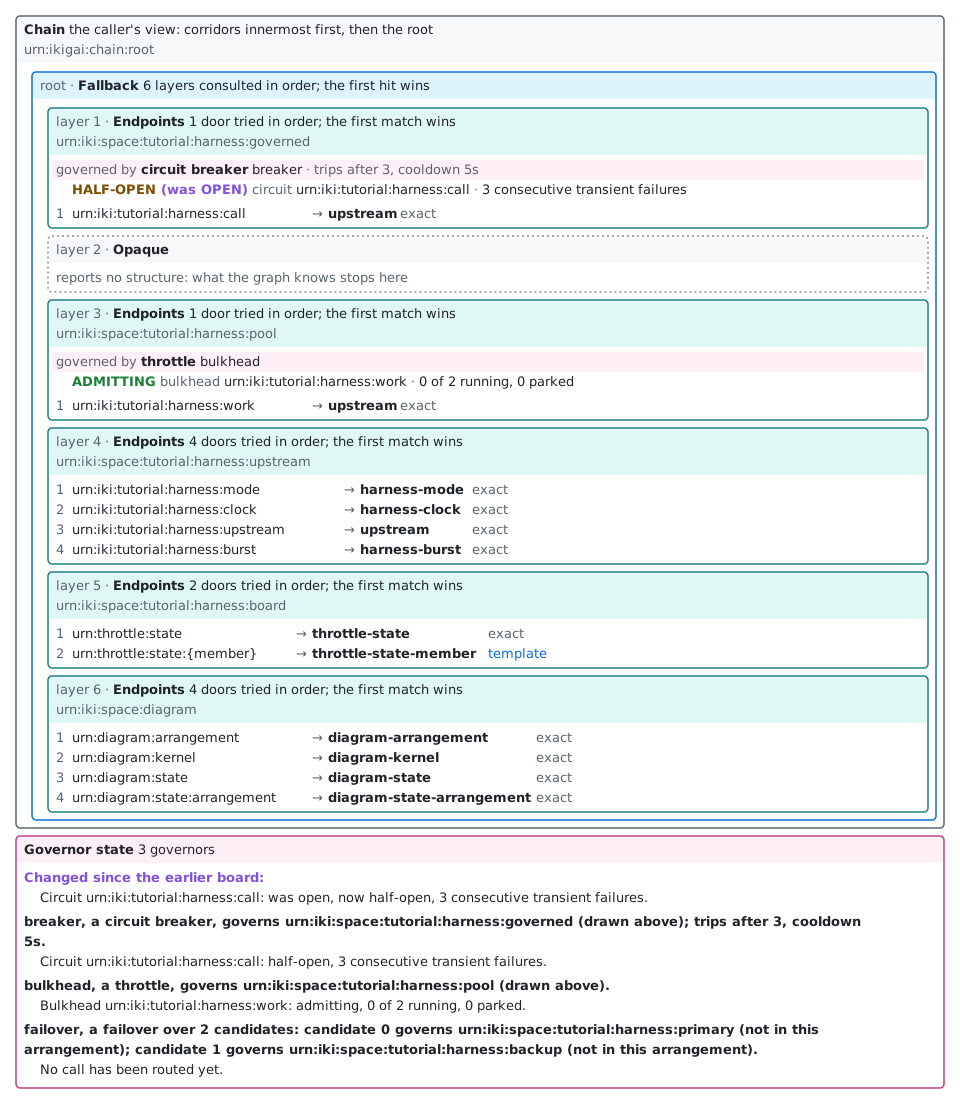
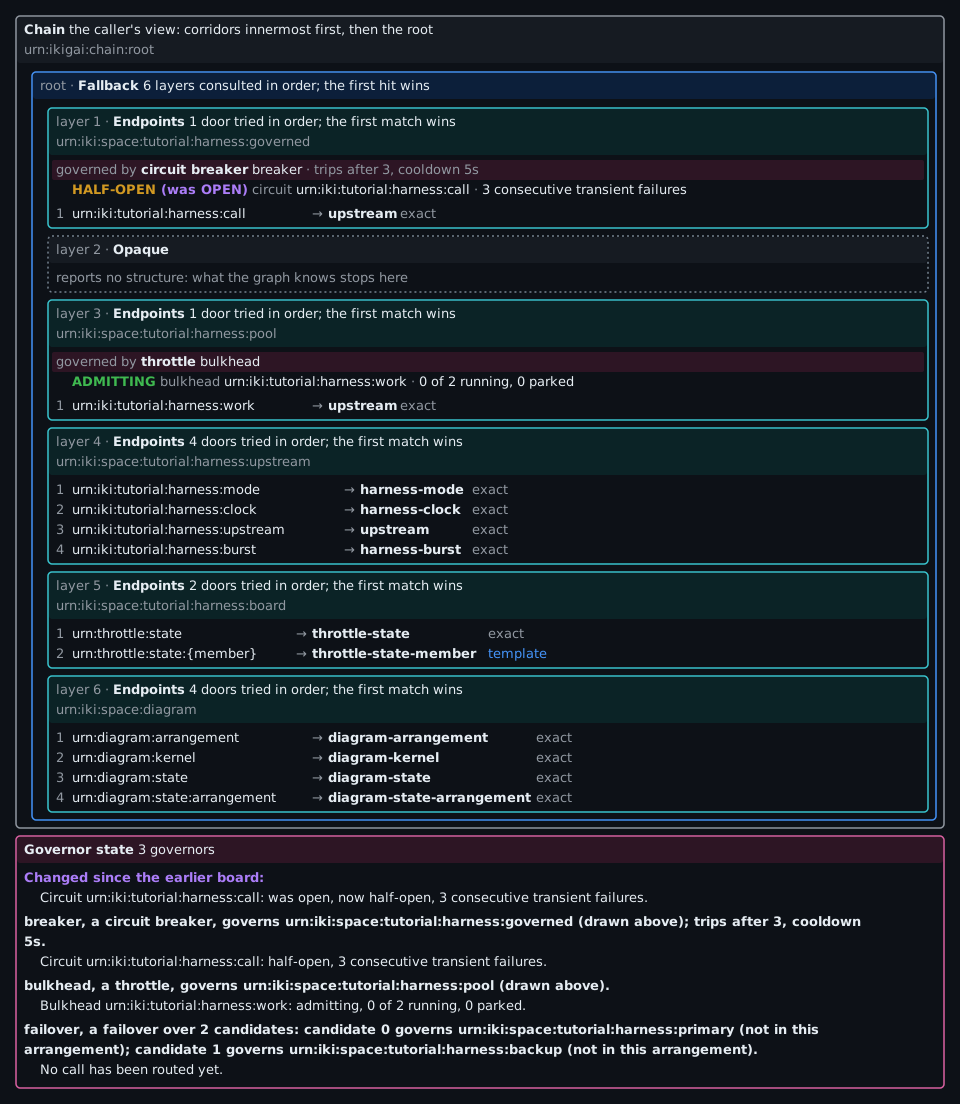
throttle state: 3 governors visible
breaker: circuit-breaker, governs urn:iki:space:tutorial:harness:governed, trips after 3, cooldown 5s
  circuit `urn:iki:tutorial:harness:call`: half-open, 3 consecutive transient failures
bulkhead: throttle, governs urn:iki:space:tutorial:harness:pool
  bulkhead `urn:iki:tutorial:harness:work`: 0 of 2 running, 0 parked
failover: failover over 2 spaces
  candidate 0: governs urn:iki:space:tutorial:harness:primary
  candidate 1: governs urn:iki:space:tutorial:harness:backup
Stage 4: the probe closes the circuit
Mend the stub and make the probe call:
the upstream is now ok
[uncacheable]
ok (call 4)
[uncacheable]
breaker: circuit-breaker, governs urn:iki:space:tutorial:harness:governed, trips after 3, cooldown 5s
  circuit `urn:iki:tutorial:harness:call`: closed, 0 consecutive transient failures
[computed]
Call 4: the probe reached the stub, it answered, and the circuit closed. Had the stub still been failing, the probe’s failure would have opened the circuit again for another cooldown.
upstream: ok · circuit `urn:iki:tutorial:harness:call`: closed, 0 consecutive transient failures · no call has gone through the failover yet · bulkhead `urn:iki:tutorial:harness:work`: 0 of 2 running, 0 parked · the harness clock reads 5s
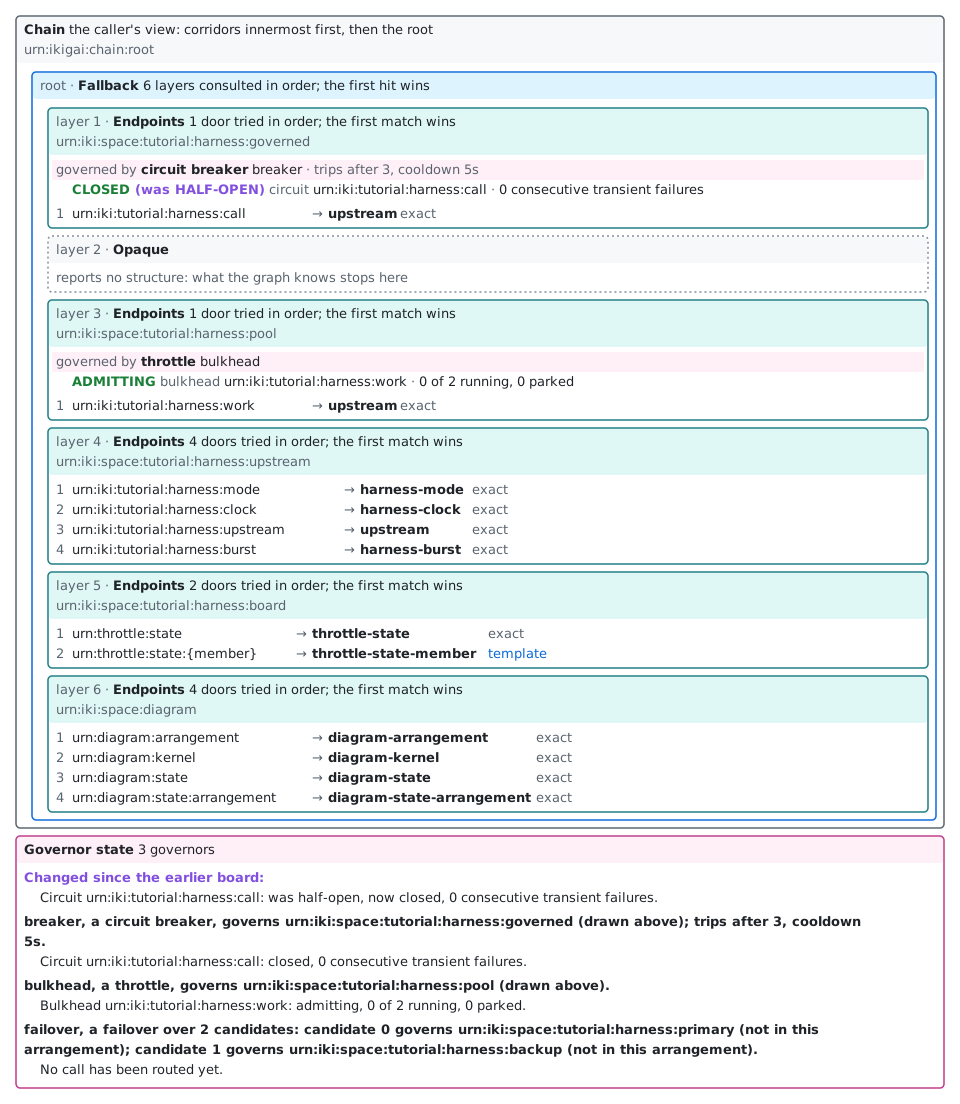
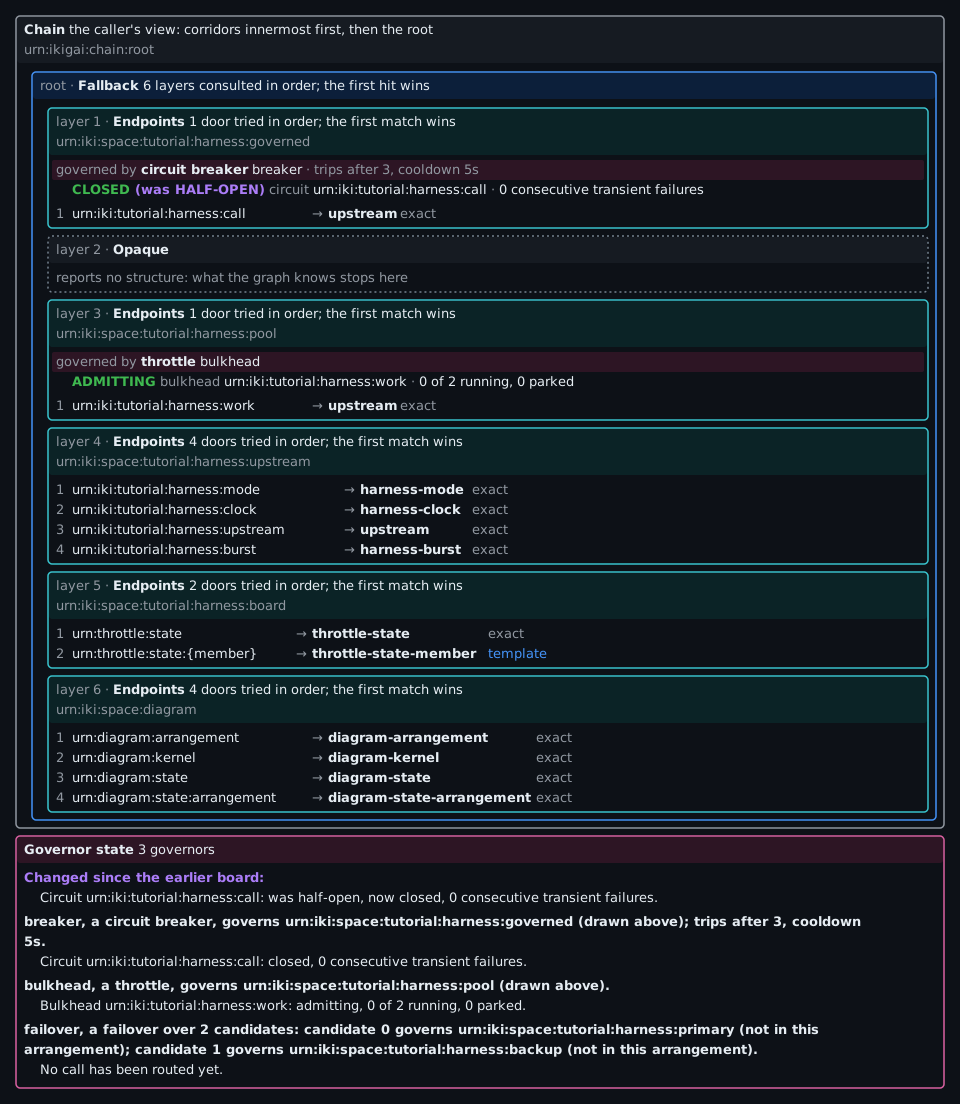
throttle state: 3 governors visible
breaker: circuit-breaker, governs urn:iki:space:tutorial:harness:governed, trips after 3, cooldown 5s
  circuit `urn:iki:tutorial:harness:call`: closed, 0 consecutive transient failures
bulkhead: throttle, governs urn:iki:space:tutorial:harness:pool
  bulkhead `urn:iki:tutorial:harness:work`: 0 of 2 running, 0 parked
failover: failover over 2 spaces
  candidate 0: governs urn:iki:space:tutorial:harness:primary
  candidate 1: governs urn:iki:space:tutorial:harness:backup
No change: the retry spends its budget
Now make the stub push back: limited answers retry after 1000 ms. This time trace the call,
so you can see inside it:
the upstream is now limited
[uncacheable]
trace  urn:iki:tutorial:harness:call
  client      ikigai repl  ·  capability: root (full authority)
  transport   embedded · in-process

urn:iki:tutorial:harness:call   upstream · failed · … · 2000ms · failed=retry-after answered-by=urn:iki:space:tutorial:harness:governed
├─ urn:iki:tutorial:harness:mode   harness-mode · computed · … · 0ms · answered-by=urn:iki:space:tutorial:harness:upstream
├─ urn:iki:tutorial:harness:mode   harness-mode · cached · … · 0ms · answered-by=urn:iki:space:tutorial:harness:upstream
└─ urn:iki:tutorial:harness:mode   harness-mode · cached · … · 0ms · answered-by=urn:iki:space:tutorial:harness:upstream
urn:iki:tutorial:harness:call   error: retry after 1000 ms: upstream limited (call 7)
Read it from the inside out. The stub reads its mode once per call, and there are three reads
under the one call you made: three attempts, calls 5, 6 and 7. (The first read is computed
because setting the mode a line earlier cut the mode’s thread; the other two are served from the
cache.) A one-second delay fits inside Retry’s two-second bound, so it waited each one out
before re-issuing, and the call took 2000 ms of harness time: two waits, two re-issues, and then
the budget of 2 was spent and the third retry after came back to you. Retry would have made
5 attempts; the run’s budget is what stopped it. And the breaker, which a retry after says
nothing to, has not moved:
the harness clock reads 7s
[uncacheable]
breaker: circuit-breaker, governs urn:iki:space:tutorial:harness:governed, trips after 3, cooldown 5s
  circuit `urn:iki:tutorial:harness:call`: closed, 0 consecutive transient failures
[cached]
trace  urn:throttle:state
  client      ikigai repl  ·  capability: root (full authority)
  transport   embedded · in-process

urn:throttle:state   throttle-state · cached · … · 0ms · answered-by=urn:iki:space:tutorial:harness:board   → …
The clock moved the two seconds the retry waited. The breaker’s key is the same answer as
before, served from the cache: nothing a governor shows changed, so nothing cut its thread.
No change, then, and the trace of the whole board says the same thing from the other side:
urn:throttle:state was served from the cache, because the page read it when the stage
happened, and nothing since has cut a thread it hangs from. The picture is a pure function of
the board and the topology, so the page’s next read of it is a cache hit too.
Stage 5: the timeout
Make the stub slow: it now takes 10 seconds, and the call’s budget is 2.
the upstream is now slow
[uncacheable]
error: timeout: `urn:iki:tutorial:harness:call` exceeded 2000ms
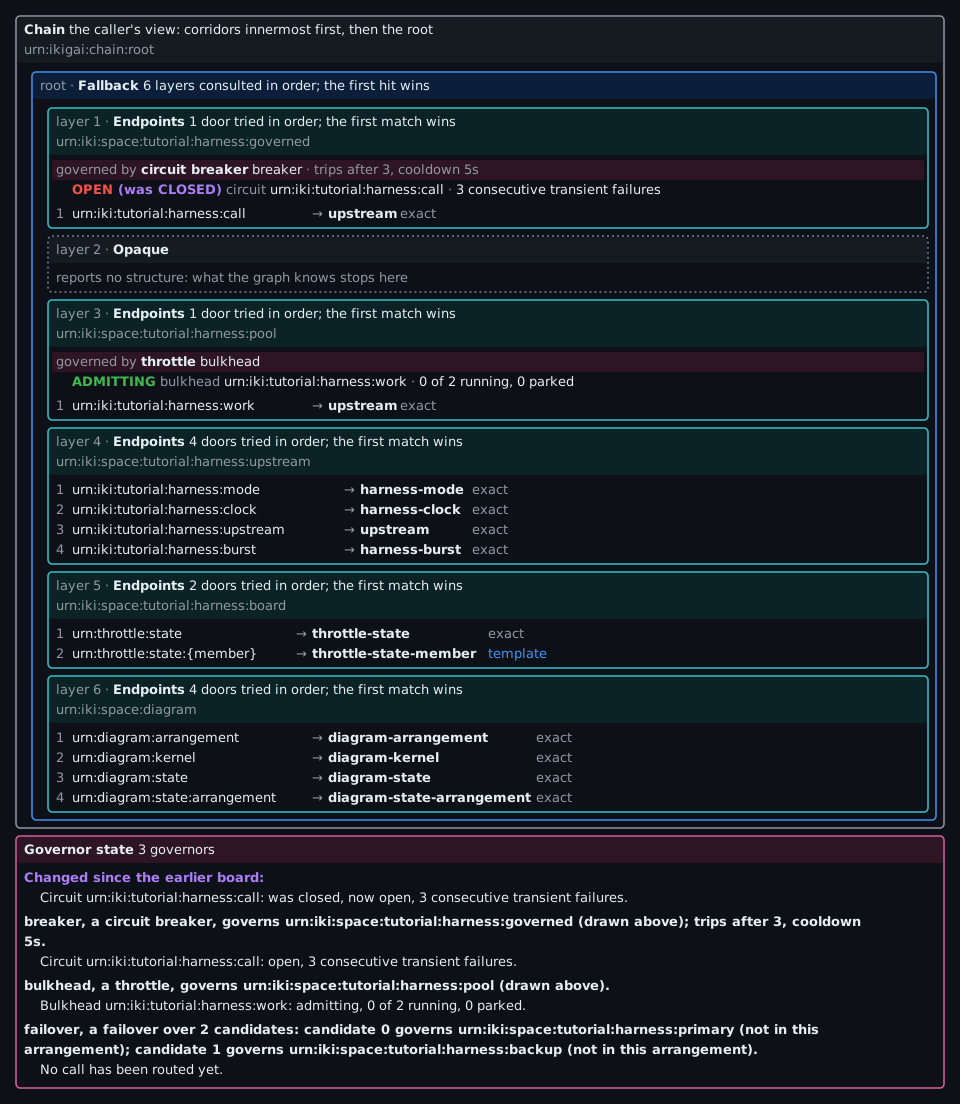
The timeout names the target it bounded, and its class is transient, because the overlay cannot tell a slow dependency (which a repeat may beat) from expensive work (which it will not). So the two governors above it treated it like any other transient failure, and the circuit opened:
upstream: slow · circuit `urn:iki:tutorial:harness:call`: open, 3 consecutive transient failures · no call has gone through the failover yet · bulkhead `urn:iki:tutorial:harness:work`: 0 of 2 running, 0 parked · the harness clock reads 13s
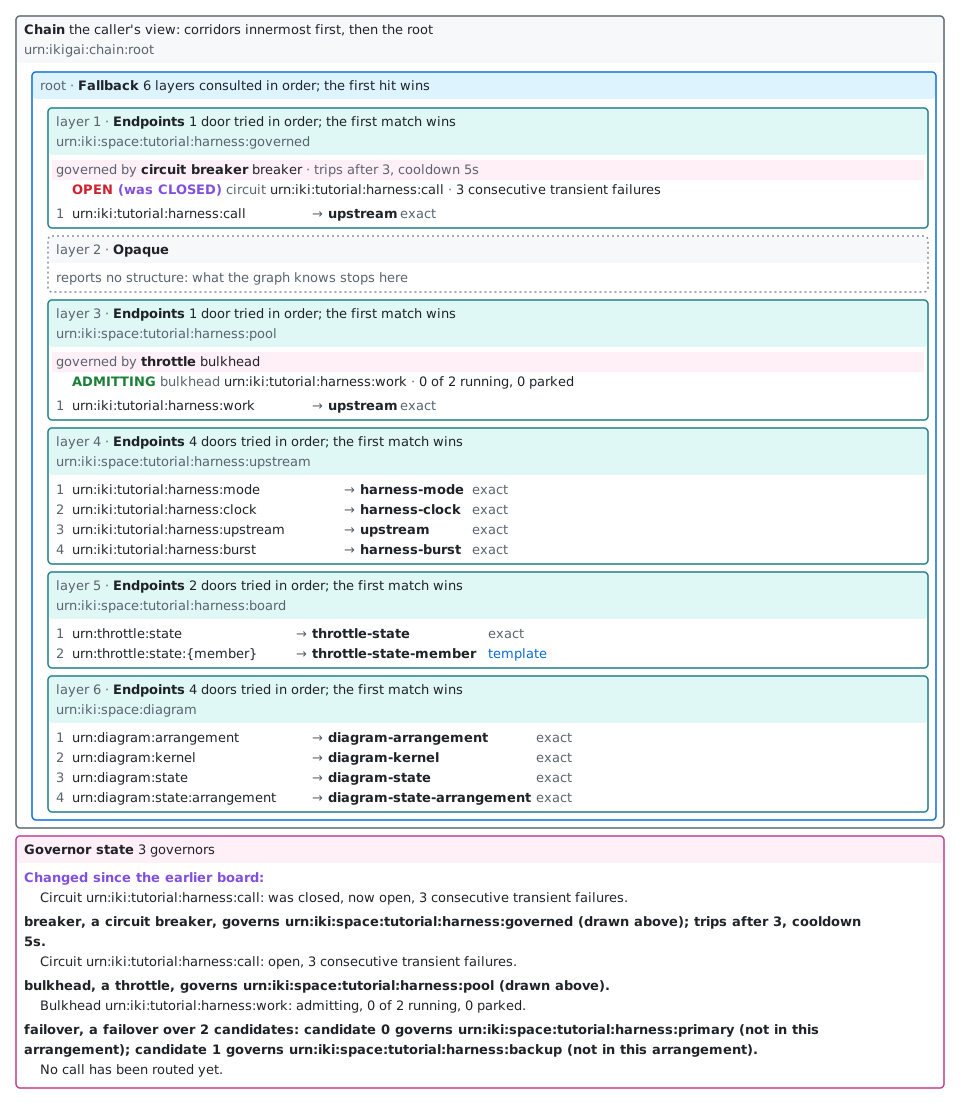
throttle state: 3 governors visible
breaker: circuit-breaker, governs urn:iki:space:tutorial:harness:governed, trips after 3, cooldown 5s
  circuit `urn:iki:tutorial:harness:call`: open, 3 consecutive transient failures
bulkhead: throttle, governs urn:iki:space:tutorial:harness:pool
  bulkhead `urn:iki:tutorial:harness:work`: 0 of 2 running, 0 parked
failover: failover over 2 spaces
  candidate 0: governs urn:iki:space:tutorial:harness:primary
  candidate 1: governs urn:iki:space:tutorial:harness:backup
The picture is the same as stage 2’s, because the state is: the breaker cannot tell a stalled dependency from a failing one, and does not need to. The clock and the board say how it got there:
the harness clock reads 13s
[uncacheable]
breaker: circuit-breaker, governs urn:iki:space:tutorial:harness:governed, trips after 3, cooldown 5s
  circuit `urn:iki:tutorial:harness:call`: open, 3 consecutive transient failures
[cached]
Six seconds: Retry re-issued twice from the budget, each attempt was cut off at its 2 seconds,
and the breaker counted three transient failures and opened. A stalled dependency trips the
breaker exactly as a failing one does, which is the point of putting the timeout inside it.
Stage 6: the same stub, ungoverned
For contrast, call the same stub with no governor in the way:
ok, slowly (call 11, after 10s)
[uncacheable]
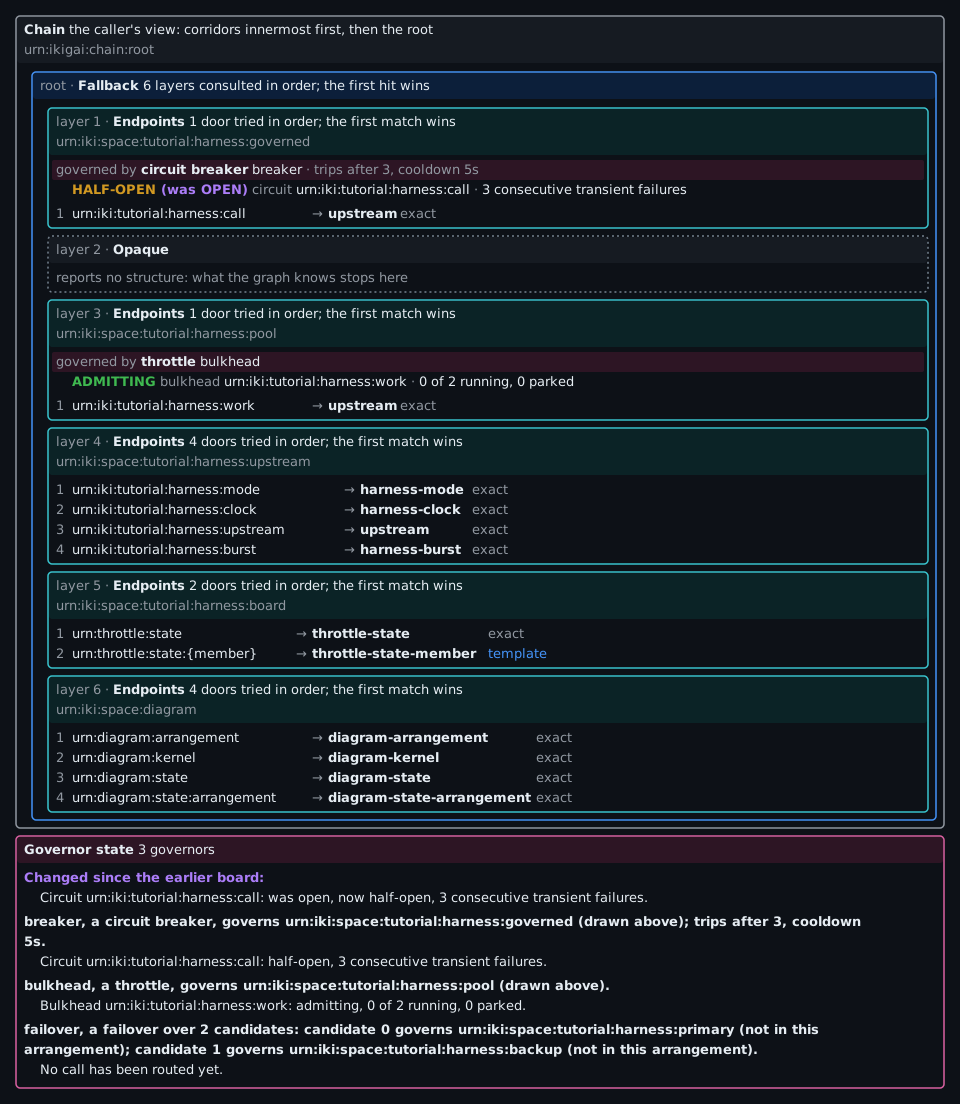
It answers, after the full 10 seconds. Without the stack, a caller waits as long as the dependency takes; with it, the caller hears in 2. And those 10 seconds were harness time: the clock moved past the open circuit’s 5-second cooldown while this call waited, so the circuit went half-open with nobody calling through it, the same way it did in stage 3:
upstream: slow · circuit `urn:iki:tutorial:harness:call`: half-open, 3 consecutive transient failures · no call has gone through the failover yet · bulkhead `urn:iki:tutorial:harness:work`: 0 of 2 running, 0 parked · the harness clock reads 23s
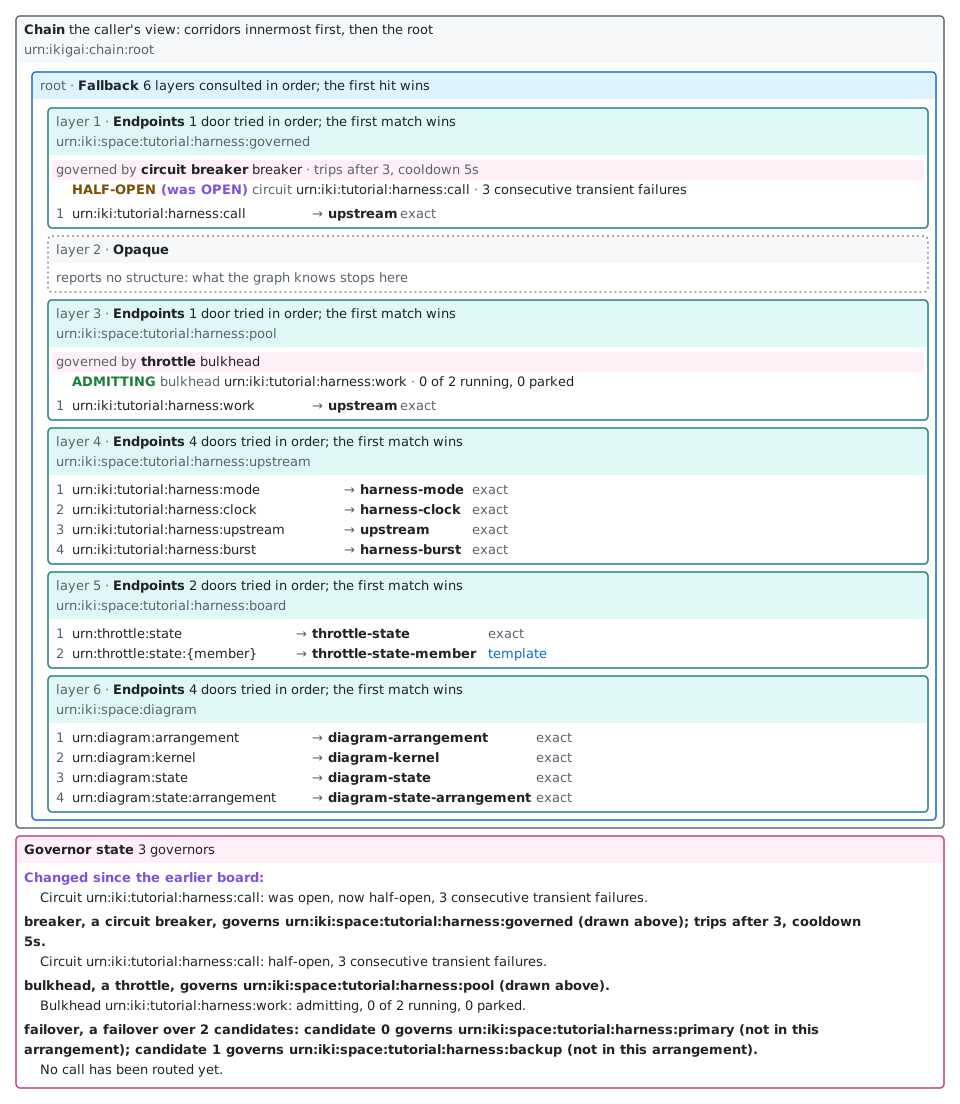
throttle state: 3 governors visible
breaker: circuit-breaker, governs urn:iki:space:tutorial:harness:governed, trips after 3, cooldown 5s
  circuit `urn:iki:tutorial:harness:call`: half-open, 3 consecutive transient failures
bulkhead: throttle, governs urn:iki:space:tutorial:harness:pool
  bulkhead `urn:iki:tutorial:harness:work`: 0 of 2 running, 0 parked
failover: failover over 2 spaces
  candidate 0: governs urn:iki:space:tutorial:harness:primary
  candidate 1: governs urn:iki:space:tutorial:harness:backup
Stage 7: the failover moves to the backup
The stub is still slow. Call it through the failover instead of the breaker:
ok from the backup (backup call 1)
[uncacheable]
The primary is the same stub, behind its own 2-second timeout. It was cut off, and a timeout is
transient, so Failover moved to the next space, the backup, which answered. The move is a
re-issue, so it spent one retry from the run’s budget, as Retry’s do. The board now holds a
route for the service: where its last call ended, at candidate 1 (the board counts a failover’s
spaces from 0, the primary first). The failover itself is the opaque box in the picture, so the
route is said in the words below it, and marked there as new.
upstream: slow · circuit `urn:iki:tutorial:harness:call`: half-open, 3 consecutive transient failures · route `urn:iki:tutorial:harness:service`: last call answered at candidate 1 · bulkhead `urn:iki:tutorial:harness:work`: 0 of 2 running, 0 parked · the harness clock reads 25s
throttle state: 3 governors visible
breaker: circuit-breaker, governs urn:iki:space:tutorial:harness:governed, trips after 3, cooldown 5s
  circuit `urn:iki:tutorial:harness:call`: half-open, 3 consecutive transient failures
bulkhead: throttle, governs urn:iki:space:tutorial:harness:pool
  bulkhead `urn:iki:tutorial:harness:work`: 0 of 2 running, 0 parked
failover: failover over 2 spaces
  candidate 0: governs urn:iki:space:tutorial:harness:primary
  candidate 1: governs urn:iki:space:tutorial:harness:backup
  route `urn:iki:tutorial:harness:service`: last call answered at candidate 1
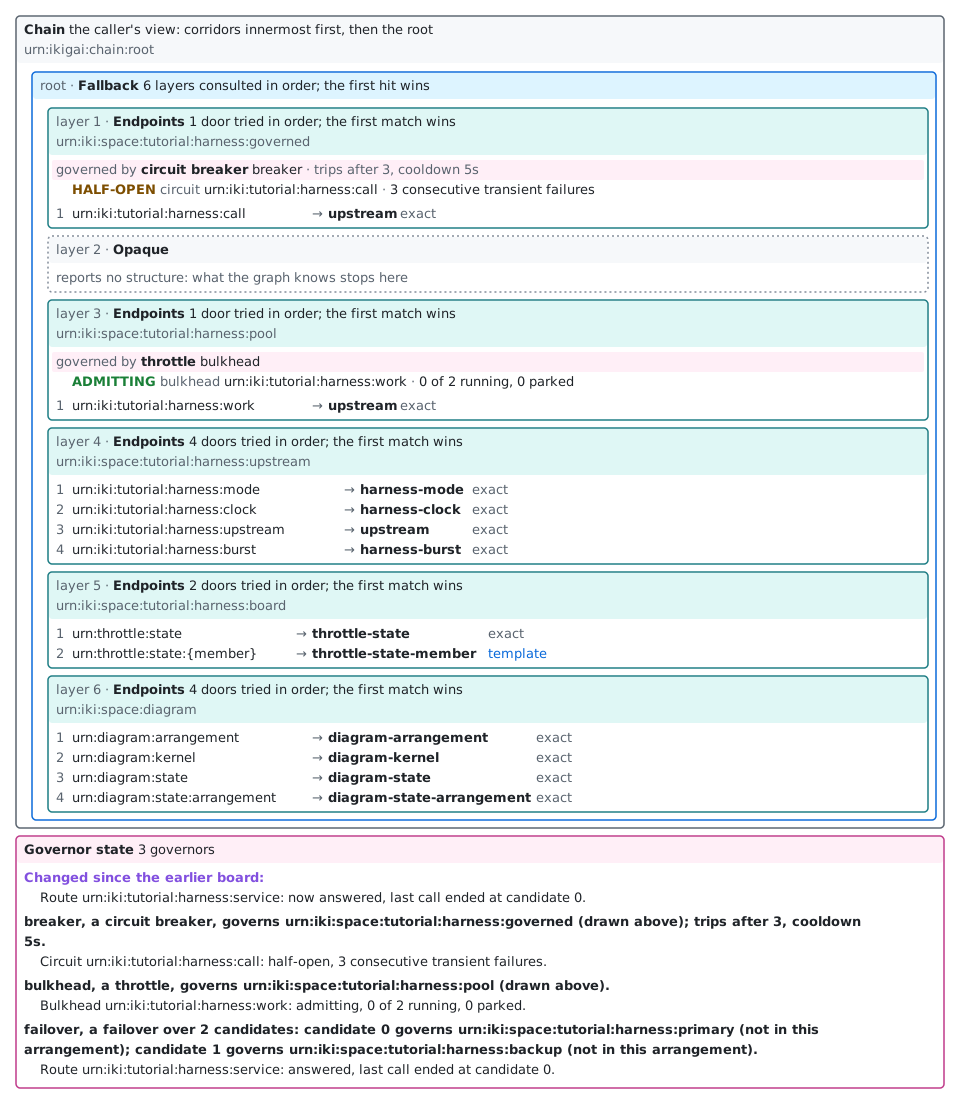
Stage 8: and back to the primary
Mend the stub and call the service again:
the upstream is now ok
[uncacheable]
ok (call 13)
[uncacheable]
A failover always tries its spaces in order, so the first call after the primary mends goes
to the primary, and the route moves back. Nothing remembers that the primary was down: that is
a breaker’s job, and wrapping the primary in a CircuitBreaker would make its trip-open the
fast trigger to move on.
upstream: ok · circuit `urn:iki:tutorial:harness:call`: half-open, 3 consecutive transient failures · route `urn:iki:tutorial:harness:service`: last call answered at candidate 0 · bulkhead `urn:iki:tutorial:harness:work`: 0 of 2 running, 0 parked · the harness clock reads 25s
throttle state: 3 governors visible
breaker: circuit-breaker, governs urn:iki:space:tutorial:harness:governed, trips after 3, cooldown 5s
  circuit `urn:iki:tutorial:harness:call`: half-open, 3 consecutive transient failures
bulkhead: throttle, governs urn:iki:space:tutorial:harness:pool
  bulkhead `urn:iki:tutorial:harness:work`: 0 of 2 running, 0 parked
failover: failover over 2 spaces
  candidate 0: governs urn:iki:space:tutorial:harness:primary
  candidate 1: governs urn:iki:space:tutorial:harness:backup
  route `urn:iki:tutorial:harness:service`: last call answered at candidate 0
Stage 9: the bulkhead fills
A bulkhead parks only concurrent work, and a cell runs one line at a time, so the harness has a
way to start several calls at once: Sink a number to urn:iki:tutorial:harness:burst, and that
many calls to urn:iki:tutorial:harness:work start together, in the background, on the harness
clock. Make the stub slow, so each call holds its slot for 10 seconds, and start five:
the upstream is now slow
[uncacheable]
started 5 calls to urn:iki:tutorial:harness:work at once: none answered and 5 calls still in flight
[uncacheable]
Two calls hold the bulkhead’s two slots, and the other three are parked: waiting, not refused. That is the difference between this governor and a rate limit: the excess is held until there is room, never turned away. The calls do not finish on their own; they move only when the harness clock does.
upstream: slow · circuit `urn:iki:tutorial:harness:call`: half-open, 3 consecutive transient failures · route `urn:iki:tutorial:harness:service`: last call answered at candidate 0 · bulkhead `urn:iki:tutorial:harness:work`: 2 of 2 running, 3 parked · the harness clock reads 25s
throttle state: 3 governors visible
breaker: circuit-breaker, governs urn:iki:space:tutorial:harness:governed, trips after 3, cooldown 5s
  circuit `urn:iki:tutorial:harness:call`: half-open, 3 consecutive transient failures
bulkhead: throttle, governs urn:iki:space:tutorial:harness:pool
  bulkhead `urn:iki:tutorial:harness:work`: 2 of 2 running, 3 parked
failover: failover over 2 spaces
  candidate 0: governs urn:iki:space:tutorial:harness:primary
  candidate 1: governs urn:iki:space:tutorial:harness:backup
  route `urn:iki:tutorial:harness:service`: last call answered at candidate 0
Stage 10: two answer, two more start
Move the clock 10 seconds:
the harness clock moved 10s: it reads 35s; in the background, 2 calls answered and 3 calls still in flight
[uncacheable]
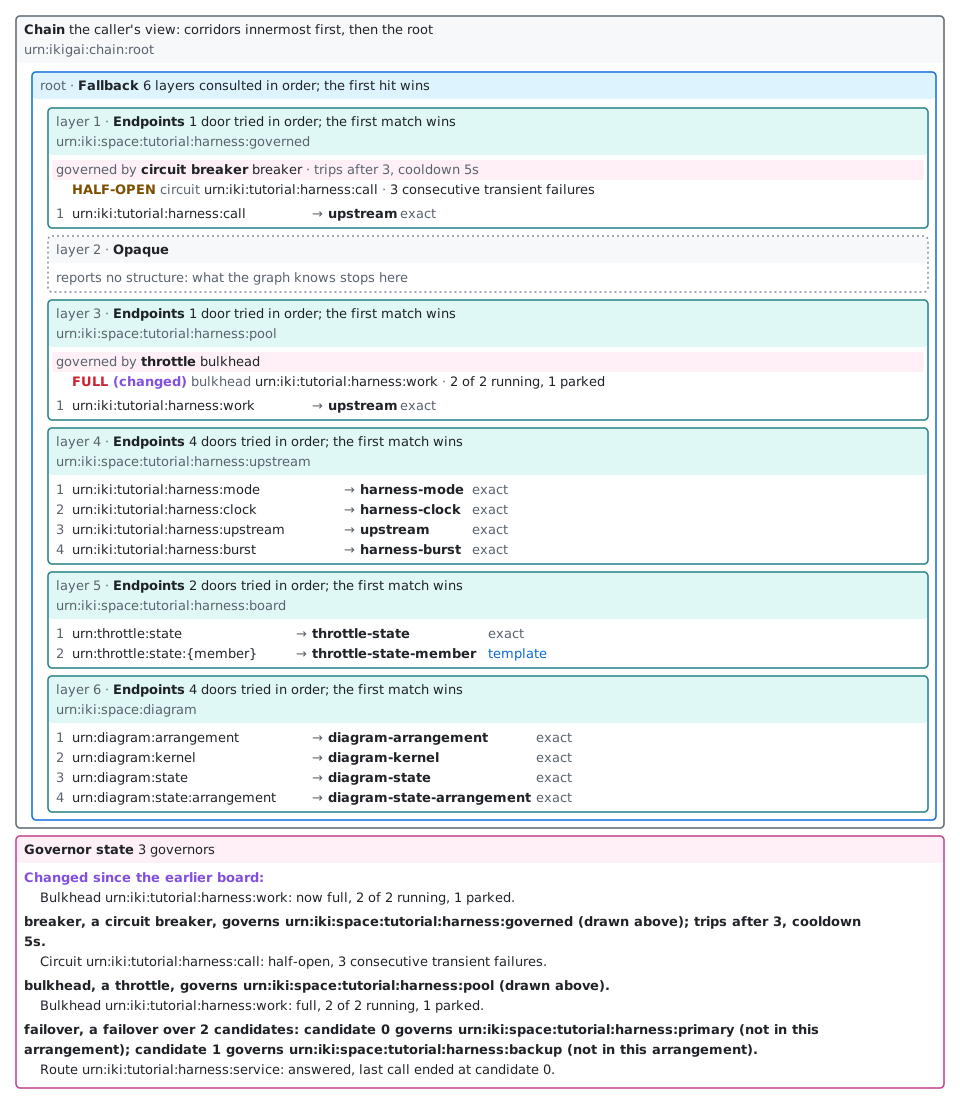
The two running calls answered at 10 seconds, which freed both slots, and two parked calls took them at that same instant. The harness runs its background work event by event: the clock steps to each wait’s deadline in turn, so a call that frees a slot lets the next one start at that moment, not at the end of the move.
upstream: slow · circuit `urn:iki:tutorial:harness:call`: half-open, 3 consecutive transient failures · route `urn:iki:tutorial:harness:service`: last call answered at candidate 0 · bulkhead `urn:iki:tutorial:harness:work`: 2 of 2 running, 1 parked · the harness clock reads 35s
throttle state: 3 governors visible
breaker: circuit-breaker, governs urn:iki:space:tutorial:harness:governed, trips after 3, cooldown 5s
  circuit `urn:iki:tutorial:harness:call`: half-open, 3 consecutive transient failures
bulkhead: throttle, governs urn:iki:space:tutorial:harness:pool
  bulkhead `urn:iki:tutorial:harness:work`: 2 of 2 running, 1 parked
failover: failover over 2 spaces
  candidate 0: governs urn:iki:space:tutorial:harness:primary
  candidate 1: governs urn:iki:space:tutorial:harness:backup
  route `urn:iki:tutorial:harness:service`: last call answered at candidate 0
Stage 11: the last one runs alone
Move the clock again:
the harness clock moved 10s: it reads 45s; in the background, 2 calls answered and 1 call still in flight
[uncacheable]
Nothing is parked now, and one slot is free: the bulkhead is admitting again.
upstream: slow · circuit `urn:iki:tutorial:harness:call`: half-open, 3 consecutive transient failures · route `urn:iki:tutorial:harness:service`: last call answered at candidate 0 · bulkhead `urn:iki:tutorial:harness:work`: 1 of 2 running, 0 parked · the harness clock reads 45s
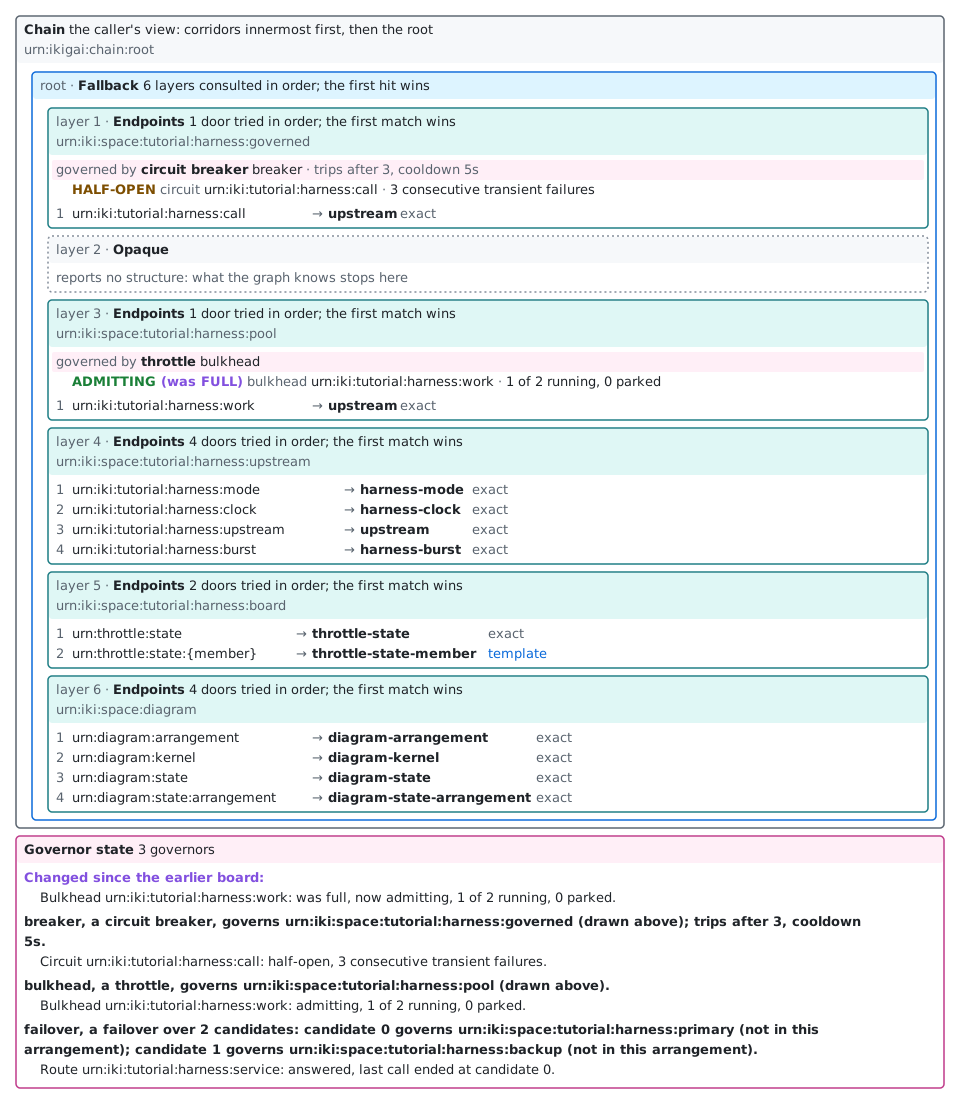
throttle state: 3 governors visible
breaker: circuit-breaker, governs urn:iki:space:tutorial:harness:governed, trips after 3, cooldown 5s
  circuit `urn:iki:tutorial:harness:call`: half-open, 3 consecutive transient failures
bulkhead: throttle, governs urn:iki:space:tutorial:harness:pool
  bulkhead `urn:iki:tutorial:harness:work`: 1 of 2 running, 0 parked
failover: failover over 2 spaces
  candidate 0: governs urn:iki:space:tutorial:harness:primary
  candidate 1: governs urn:iki:space:tutorial:harness:backup
  route `urn:iki:tutorial:harness:service`: last call answered at candidate 0
Stage 12: drained
And once more:
the harness clock moved 10s: it reads 55s; in the background, 1 call answered and none is in flight
[uncacheable]
Five calls, at most two at a time, each 10 seconds long: they answered 10, 10, 20, 20 and 30 seconds after they started, 30 seconds of harness time in all, where five calls at once would have taken 10. The bulkhead traded the last caller’s wait for a cap on how much of the stub any burst can hold.
upstream: slow · circuit `urn:iki:tutorial:harness:call`: half-open, 3 consecutive transient failures · route `urn:iki:tutorial:harness:service`: last call answered at candidate 0 · bulkhead `urn:iki:tutorial:harness:work`: 0 of 2 running, 0 parked · the harness clock reads 55s
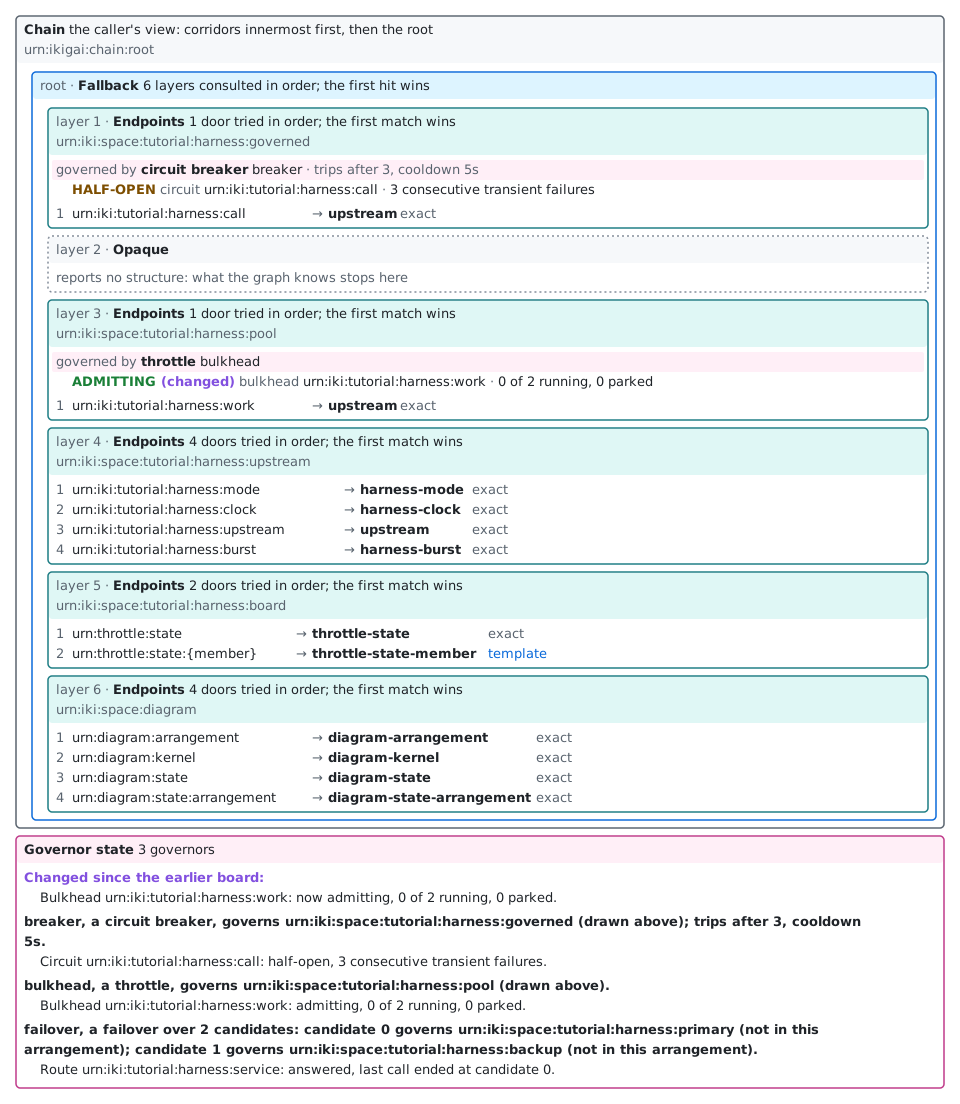
throttle state: 3 governors visible
breaker: circuit-breaker, governs urn:iki:space:tutorial:harness:governed, trips after 3, cooldown 5s
  circuit `urn:iki:tutorial:harness:call`: half-open, 3 consecutive transient failures
bulkhead: throttle, governs urn:iki:space:tutorial:harness:pool
  bulkhead `urn:iki:tutorial:harness:work`: 0 of 2 running, 0 parked
failover: failover over 2 spaces
  candidate 0: governs urn:iki:space:tutorial:harness:primary
  candidate 1: governs urn:iki:space:tutorial:harness:backup
  route `urn:iki:tutorial:harness:service`: last call answered at candidate 0
Rate limits are still only described here, by the table above: a RateLimit refuses where a
Throttle parks, and the harness does not drive one yet.