A space that changes while it runs
Tic-tac-toe, VII moved the game’s arrangement into a file. The endpoints
stayed in Rust, in a Registry, and core’s build read the file once, when the kernel was
made, and handed back a space. It also drew that space with ikigai_diagram::render. What it
could not do is change the space afterwards: to give the game a door it did not have, you
edited the file and built a new kernel.
This chapter keeps the same two halves, a registry of endpoints and a declaration that only
arranges them, and lets the declaration change while the kernel runs. The tool is
ikigai-core’s DynamicSpace (0.1.109, ledger #2006): a space inside the host’s root that
rebuilds itself from a declaration resource whenever that resource is written. The root
never changes. Only the doors inside the dynamic space do.
It leans on one rule from Golden threads in practice: a cut takes what hung from it. Every answer a dynamic space serves hangs from one thread that the space owns, and every change to the space cuts that thread. That is why a removed door takes its cached answers with it.
Nothing here needs a server or a REPL. If a ttt-host or an ikigai serve from an earlier
chapter is still running, it can stay running: this chapter uses neither. Every listing below
runs on every build of the book, against the crate crates/live-space.
The same host also runs in this page. The cells below that say “in the live host” run their
lines in it: the root crates/live-space builds, with an empty dynamic space called
workshop, started the first time you press Run in one of them. It is a kernel of its own,
beside the one the book’s other cells share, because that one already binds Part I’s names,
and an empty space would not look empty in front of them. Its rebuild loop is the chapter’s
drive, running on the page’s own event loop. Run the cells in order: each one changes the
host the next one reads. The four parts of the chapter that change the space are numbered
stages, one tab each, with the space drawn as it was after each one (below).
The host
The registry holds four endpoints the book already wrote: Part I’s camel-case, title and
camel-title (from Hello, resource), and ikigai-fn’s
toUpper. Each is registered under the name it gives itself, and none of them is bound to
any name yet:
/// Every endpoint the dynamic space may bind, by the name each gives itself. A
/// declaration that names anything else is refused, and binds nothing.
pub fn registry(title: Arc<TitleState>) -> Registry {
    let mut registry = Registry::new();
    for endpoint in [
        Arc::new(hello_camel::camel_case()) as Arc<dyn ikigai_core::Endpoint>,
        Arc::new(hello_camel::title(title)),
        Arc::new(hello_camel::camel_title()),
        Arc::new(ikigai_fn::to_upper()),
    ] {
        registry.register(endpoint).expect("four distinct names");
    }
    registry
}
They are three kinds of endpoint: a pure function of its argument (camel-case, toUpper),
an endpoint over state the host holds (title), and a composite that reads another resource
through the kernel (camel-title reads title). The registry does not care which is which.
A declaration binds a door to an endpoint by its name, and never makes one.
The declaration lives at a name of its own:
/// Where the dynamic space's declaration lives. A write to it is a change to the space.
pub const DECLARATION: &str = "urn:iki:tutorial:live:declaration";

/// Where the host says its dynamic space in words ([`words`]): what the page's stages viewer
/// compares from one stage to the next.
pub const WORDS: &str = "urn:iki:tutorial:live:arrangement";

/// `view.arrangement`: a declaration holding one view, `urn:iki:tutorial:live:picture`, onto
/// `urn:diagram:kernel`, as the s-expression the chapter writes. `:resolve-at root` is what makes
/// the rule a view (ikigai-sexpr 0.2.4 reads and prints it).
pub const VIEW: &str = include_str!("../view.arrangement");

/// `view.ttl`: the same declaration as [`VIEW`], as the `ik:` Turtle core reads, where the view
/// is `ik:resolveAt "root"`.
pub const VIEW_TURTLE: &str = include_str!("../view.ttl");

/// The first declaration the chapter writes: all four endpoints, bound.
pub const FOUR_DOORS: &str = r#"(endpoints
  (door "urn:iki:tutorial:camel-case" camel-case)
  (door "urn:iki:tutorial:title" title)
  (door "urn:iki:tutorial:camel-title" camel-title)
  (door "urn:iki:tutorial:upper" toUpper))"#;
Sink writes an arrangement there, in the s-expression form Tic-tac-toe VII’s file is
written in; Source answers it as the ik: Turtle core builds from. Beside it is the dynamic
space in words, urn:iki:tutorial:live:arrangement: a line for the space, and one for each
space and door it holds, read from the kernel’s topology, so it says what is in force rather
than what was last written. The host’s root is three layers: those two, then ikigai-diagram‘s
space (urn:diagram:kernel, the picture Tic-tac-toe VII drew from a file, here drawn from the
running kernel, beside the urn:diagram:state pair that draws governors’ state over an
arrangement, which this chapter does not use), then the dynamic space:
/// The root of a host for `dynamic`: the declaration and the dynamic space in words, then the
/// picture of the host's own arrangement, then the dynamic space. The layers are consulted in order, so a door the declaration
/// binds can never shadow the declaration itself.
pub fn root(
    declaration_state: Arc<DeclarationState>,
    dynamic: Arc<DynamicSpace>,
) -> Arc<dyn Space> {
    let fixed = EndpointSpace::new()
        .bind(Exact::new(DECLARATION), declaration(declaration_state))
        .bind(Exact::new(WORDS), words());
    Arc::new(Fallback::new(vec![
        Arc::new(fixed),
        Arc::new(ikigai_diagram::space()),
        dynamic,
    ]))
}

/// The kernel over [`root`], with the Meta renderer Part I's host uses.
pub fn kernel(root: Arc<dyn Space>) -> Kernel {
    Kernel::with_meta_renderer(root, Arc::new(TurtleRenderer))
}
The order matters: no door the declaration binds can shadow the declaration, or the picture.
Starting the host is three steps: make the space, put it in the kernel, and start the loop that rebuilds it:
    /// Make an empty dynamic space called `name`, put it in a host, and start the loop
    /// that rebuilds it from [`DECLARATION`].
    pub fn start(name: &str) -> Host {
        let title = Arc::new(TitleState::default());
        let space = Arc::new(DynamicSpace::new(
            name,
            Iri::parse(DECLARATION).expect("a constant IRI"),
            registry(Arc::clone(&title)),
        ));
        let root = root(Arc::default(), Arc::clone(&space));
        let kernel = Arc::new(kernel(Arc::clone(&root)));
        // The host's loop: read the declaration, bind it, and wait for its thread to be
        // cut, forever. Core has no runtime, so the host spawns it on one.
        let pool = LocalPool::new();
        let (looping, on) = (Arc::clone(&space), Arc::clone(&kernel));
        pool.spawner()
            .spawn_local(async move {
                let stopped = looping.drive(&on, &Capability::root()).await;
                panic!("the rebuild loop stopped: {stopped}");
            })
            .expect("spawn the rebuild loop");
        let mut host = Host {
            kernel,
            root,
            space,
            title,
            pool,
        };
        host.settle();
        host
    }
DynamicSpace::new is where the space gets its name. "workshop" becomes
urn:iki:space:dynamic:workshop, which is the space’s name, the name of the thread every
answer it serves hangs from, and the prefix of its status door.
drive is the host’s loop. It listens for cuts of the declaration’s thread, reads the
declaration, binds it if it is good, and waits again. A space’s resolve is synchronous and
cannot read a resource, so the rebuild happens here, outside resolution, when the
declaration changes. Core has no runtime, so the host runs the loop on one. Here that is a
LocalPool, and Host::write lets it catch up after each write, so each listing reads in
order:
    /// Write `declaration` to [`DECLARATION`], as any client with the authority to write it
    /// could, then let the loop run until it has nothing left to do.
    pub fn write(&mut self, declaration: &str) {
        let write = Request::new(Verb::Sink, Iri::parse(DECLARATION).expect("a constant IRI"))
            .with_arg("content", ArgRef::Inline(declaration.as_bytes().to_vec()));
        block_on(self.kernel.issue(write, &Capability::root())).expect("the write");
        self.settle();
    }
The write is an ordinary Sink. The kernel cuts the declaration’s thread after it, as it
does after every write, and the loop hears that cut. Nothing else tells the space to change.
The space, in stages
The kernel’s state first: the whole host, as urn:diagram:kernel draws it. Before anything
is declared it looks like this, and once the page’s host is running, every step you take below
redraws it here, so this picture is always the kernel as it is now:
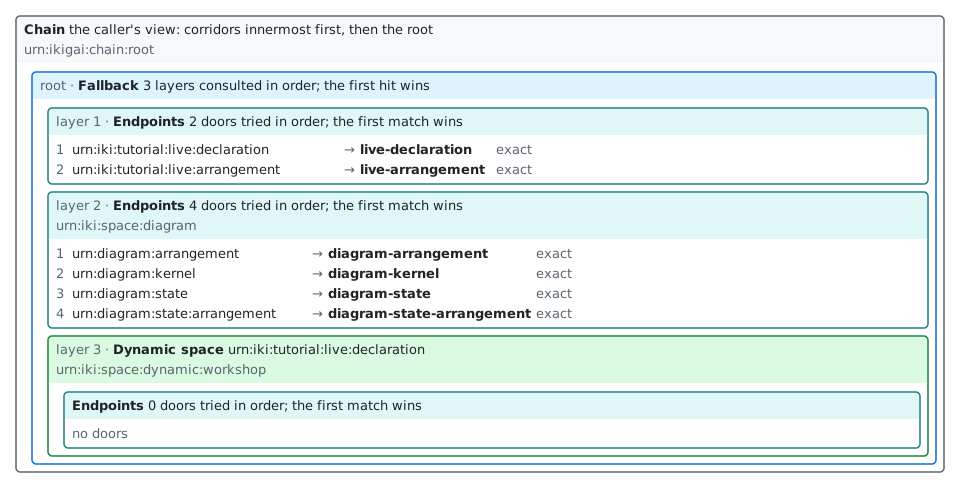
urn:diagram:kernel, as the
host in crates/live-space answers it, held to it byte for byte by a test. Select
the picture to open it at full size.The third layer is the dynamic space: its name, the declaration it is built from, and inside it, before anything is declared, an endpoint space with no doors. The status door is not drawn. The space answers it itself, ahead of anything a declaration binds, so no declaration can shadow it.
Only the third layer changes, so the stages below draw only it: focus= on urn:diagram:kernel
(ikigai-diagram 0.2.4) draws one space and what it encloses, which is also what keeps the picture
legible on a narrow screen.
How to read the stages. A stage is the space after a step that changed it, and each one is a
numbered tab. Below the tabs, two pictures sit side by side (stacked on a phone): After is the
open tab’s stage, and Before is the stage you compare it with, the one just before unless you
pick another from the “Compare with” list above them. Under them is what changed from Before to After, in words (the
space’s words, urn:iki:tutorial:live:arrangement, compared line by line: the words that differ
are marked, and what they replaced is said beside them). Below that is the tab’s step: a sentence
or two and a cell, whose Run button runs the step in this page’s host.
Each picture says whose it is. Until you run a tab’s step, its picture is the chapter’s own, in a dashed frame; run it, and After becomes the picture your host drew, in a solid frame. Run the tabs in order: each step starts where the one before left the space. A cell that changes nothing the space holds makes no stage. The line above the tabs keeps two facts current, each read from the space’s status door after every cell: how many declarations have bound, and the last refusal. How each step works, as a Rust listing that runs on every build of the book, is after the stages.
Every picture is drawn once. Both pictures are resources like any other: urn:diagram:kernel
is a pure function of the kernel’s topology, so the kernel caches it, and the cached picture
hangs from urn:kernel:bindings, the thread every successful bind cuts. After every cell you run,
the page asks for both, the whole host above and the space below, as your own lines would. A cell that bound a new declaration cut the
thread, so the picture is drawn again, once; a cell that cut nothing gets the cached picture, and
the page says so. Switching tabs, or what you compare with, asks for nothing at all: each tab keeps the picture
its step drew.
The chapter’s own pictures are files the same host drew natively, held to it byte for byte by a
test, so they show before the page’s kernel loads, without it, and in print.
- installs: 0
- refused: the declaration could not be read: not found: urn:iki:tutorial:live:declaration
An empty space, with a name
Start the host, and ask the space what it holds: its status door,
urn:iki:space:dynamic:workshop:status, and camel-case, a name the registry could serve. The
host starts the first time a cell in it runs:
space: urn:iki:space:dynamic:workshop
declaration: urn:iki:tutorial:live:declaration
in force: nothing (the space is empty)
installs: 0
refused: the declaration could not be read: not found: urn:iki:tutorial:live:declaration
[uncacheable]
error: no endpoint resolved for urn:iki:tutorial:camel-case
The space as it starts, which is the first stage:
installs: 0 · refused: the declaration could not be read: not found: urn:iki:tutorial:live:declaration


dynamic space urn:iki:space:dynamic:workshop, built from urn:iki:tutorial:live:declaration
  holding: an endpoint space with no doors
The status says what is in force (nothing), how many declarations have bound (none), and
why: the loop’s first read found no declaration. A space that cannot read its declaration
binds nothing, rather than guessing. Until a declaration binds, every name in it answers
Unresolved.
Doors, added by a write
Now write a declaration that binds all four endpoints. Three doors use the names Part I
used. toUpper gets one in the tutorial’s namespace, urn:iki:tutorial:upper, because the
declaration chooses the names and the endpoint does not. In the page, the write is a sink to
the declaration, on one line, and the reads after it ask each door and the status. Run it after
stage 1’s cell:
ok
[uncacheable]
resourceOrientedComputing
[computed]
RESOURCE ORIENTED COMPUTING
[computed]
resourceOrientedComputing
[computed]
space: urn:iki:space:dynamic:workshop
declaration: urn:iki:tutorial:live:declaration
in force: b3:1fb3e978a7d7700944d5cb5ece16d741453c3de61ad7547be867d4ff14f0bbef
installs: 1
refused: nothing since the last bind
[uncacheable]
The write bound, so the space changed, and this is the second stage:
installs: 1 · refused: nothing since the last bind
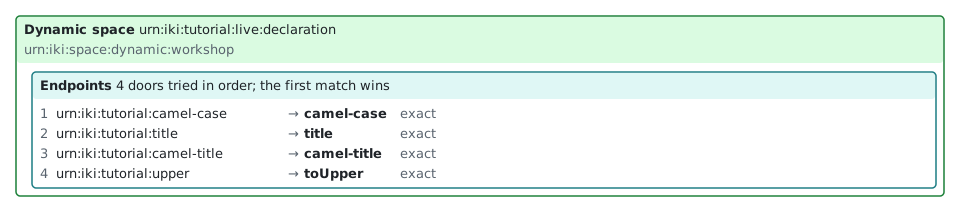
dynamic space urn:iki:space:dynamic:workshop, built from urn:iki:tutorial:live:declaration
  holding: an endpoint space with 4 doors, tried in order
    door urn:iki:tutorial:camel-case, answered by camel-case
    door urn:iki:tutorial:title, answered by title
    door urn:iki:tutorial:camel-title, answered by camel-title
    door urn:iki:tutorial:upper, answered by toUpper
All four answer, and camel-title still reads title through the kernel, as it did in
Part I. Its sub-request resolves from the root, finds title in the dynamic space, and
composes as before. The status counts one install. Its in force line is now the digest of
the declaration that bound.
The picture changed without anyone asking for it to change. urn:diagram:kernel is a
pure function of urn:kernel:topology, so it is cached, and the topology hangs from the
kernel’s bindings thread, urn:kernel:bindings. A successful bind cuts that thread. That cut
is the only thing that makes the picture stale: nothing polls, and nothing redraws a picture
nobody asks for. The words hang from the same thread, for the same reason, and the page’s next
read of each draws the stage below the tabs.
A page that listens for that thread (see Spreadsheet, VII, later in the book) would redraw the picture the moment a change binds, with nobody running anything. That is push, and the bindings thread is what it would listen to.
A door removed, and what it served
Before you change a space, you can ask what the change will cost. Every answer the space has
served hangs from its thread, so urn:kernel:dependents lists them, as it did for title’s
thread in Golden threads in practice. After stage 2’s
cell: read camel-title (cached, since that cell read it), ask what hangs from the space’s
thread, remove the door with a declaration without camel-title, and ask both again:
resourceOrientedComputing
[cached]
dependents of urn:iki:space:dynamic:workshop  (cut 1 time)
  4 live cached entries hang from it — a cut makes them stale, and the next read of each recomputes it
  urn:iki:tutorial:camel-case   text/plain                     25 B  2 threads   root
  urn:iki:tutorial:camel-title  text/plain                     25 B  3 threads   root
  urn:iki:tutorial:title        text/plain                     27 B  2 threads   root
  urn:iki:tutorial:upper        text/plain                     27 B  2 threads   root
[uncacheable]
ok
[uncacheable]
error: no endpoint resolved for urn:iki:tutorial:camel-title
dependents of urn:iki:space:dynamic:workshop  (cut 2 times)
  (no live cached entry hangs from it: a cut would recompute nothing)
[uncacheable]
The door is gone from the space, which makes the third stage:
installs: 2 · refused: nothing since the last bind
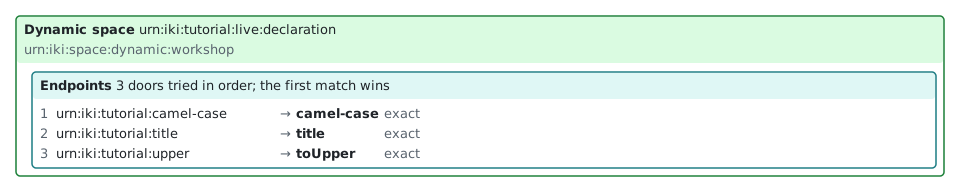
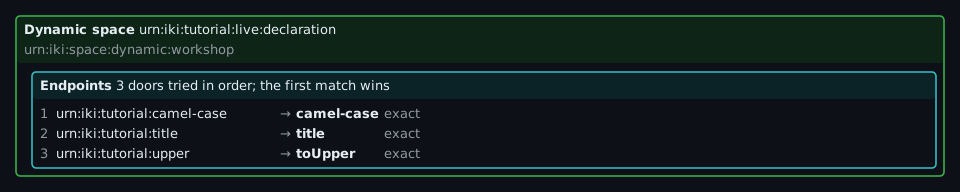
dynamic space urn:iki:space:dynamic:workshop, built from urn:iki:tutorial:live:declaration
  holding: an endpoint space with 3 doors, tried in order
    door urn:iki:tutorial:camel-case, answered by camel-case
    door urn:iki:tutorial:title, answered by title
    door urn:iki:tutorial:upper, answered by toUpper
camel-title answers Unresolved, the same answer as a name that was never bound, and its
cached answer is gone. If the cache had kept it, a reader would be served an answer from a
door that no longer exists, and no read could tell them so.
The (cut 1 time) is the first bind. A space’s thread is cut by every bind, including the
one that filled it.
A change refused
A declaration may only arrange what the host registered. This cell writes one that keeps
toUpper and adds a Lisp function, lisp-reverse, which this host never registered. After the
cell above: read camel-case (computed again, because the last cell’s write cut what the space
had served), write the refused declaration on one line, ask the status, read camel-case again,
ask whether the stage’s picture is still cached (the light one, exactly as the stages viewer
asks for it), and try the door the refused declaration wanted:
resourceOrientedComputing
[computed]
ok
[uncacheable]
space: urn:iki:space:dynamic:workshop
declaration: urn:iki:tutorial:live:declaration
in force: b3:f7851677bf49b2836e3bde448d7426881777cf6b4ef1c84eb1ee6da1090b0993
installs: 2
refused: <urn:ikigai:space:_:1:door:2> binds `lisp-reverse`, which the host did not register: a declaration arranges registered endpoints and never mints one
refused at: urn:ikigai:space:_:1:door:2
refused digest: b3:ce2d0b4eba8293992408c920f12d708cb45646334556b046ad6fd1985cb66605
[uncacheable]
resourceOrientedComputing
[cached]
cached
error: no endpoint resolved for urn:iki:tutorial:reverse
installs: 2 counts the two declarations the cells above bound; the refused one is not
among them. The in force digest is still the last good one’s, and camel-case, read just
before the write, is served from the cache after it. So is the picture: the refusal cut
neither the space’s thread nor the kernel’s bindings, so the picture and the words are the
same three doors they were before it. No change, then: this cell makes no stage. The
line above the tabs moves, because the status says what was refused, but nothing the space
holds did.
A view: a name for a name the host already serves
This cell writes a declaration that is one view and nothing else: a name,
urn:iki:tutorial:live:picture, asked again at the root as urn:diagram:kernel, the picture the
host already serves. A declaration is the whole space, so the three doors the cells above left
go. After the write: the status, a trace of the view (its answer is the picture, so the trace
shows the first bytes of it, and the sub-request the view made at the root), and then a refused
caller. cap narrows the cell’s session to urn:cap:kernel:listen, both names are refused in
the same words, and cap reset widens the session back to root:
ok
[uncacheable]
space: urn:iki:space:dynamic:workshop
declaration: urn:iki:tutorial:live:declaration
in force: b3:401d33fef281fe3eba936a037cd2aa691a44f5105f53bc408daec623d9c31991
installs: 3
refused: nothing since the last bind
[uncacheable]
trace  urn:iki:tutorial:live:picture
  client      ikigai repl  ·  capability: root (full authority)
  transport   embedded · in-process

urn:iki:tutorial:live:picture   ? · computed · ThreadId(1) · — · answered-by=urn:iki:space:dynamic:workshop   → 9291b  <svg xmlns="http://www.w3.org/2000/svg" …
└─ urn:diagram:kernel   diagram-kernel · computed · ThreadId(1) · — · answered-by=urn:iki:space:diagram defaulted=scheme
   └─ urn:kernel:topology   kernel-topology · computed · ThreadId(1) · — · defaulted=as
narrowed — capability: urn:cap:kernel:listen
error: denied: capability does not grant `urn:cap:kernel:inspect` (declared by `urn:diagram:kernel`)
error: denied: capability does not grant `urn:cap:kernel:inspect` (declared by `urn:diagram:kernel`)
reset to identity — capability: root (full authority)
The trace is the view at work: the dynamic space answered the name, and its answer came from
a sub-request for urn:diagram:kernel, which the diagram’s space answered at the root. The
two refusals are the same line, word for word: the view added no authority, and it took none
away either. cap reset matters to what comes after this cell: the stages viewer reads the
picture and the words as lines in the cell’s own session, which a cell left narrowed would
leave unable to read either.
The view is now the dynamic space’s only content, one rule, and the fourth stage:
installs: 3 · refused: nothing since the last bind
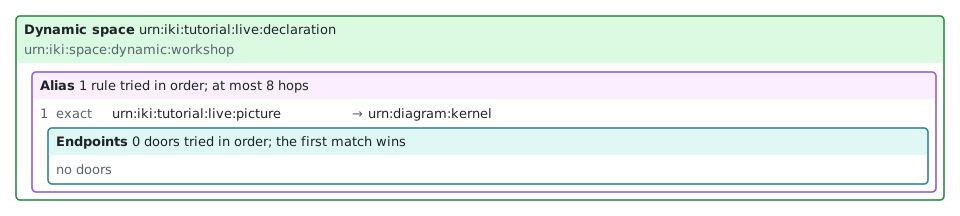
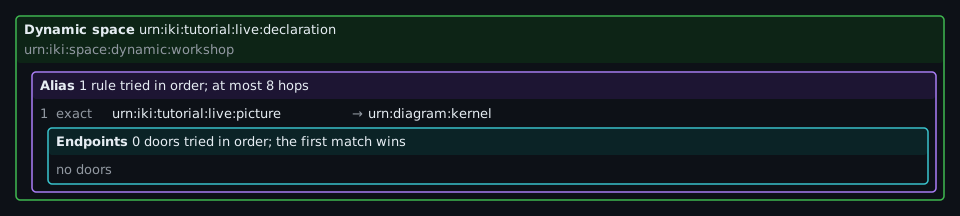
dynamic space urn:iki:space:dynamic:workshop, built from urn:iki:tutorial:live:declaration
  holding: an alias with 1 rule
    rule urn:iki:tutorial:live:picture to urn:diagram:kernel, asked again from the root
    over: an endpoint space with no doors
The stages in Rust
Every stage above, as a listing that runs on every build of the book against the same host, in
crates/live-space, with the background the stages lean on.
Stage 1: an empty space, with a name
The same two questions in Rust:
#![allow(unused)]
fn main() {
extern crate live_space;
extern crate ikigai_core;
use ikigai_core::Error;
use live_space::{source, Host};

let host = Host::start("workshop");

let status = host.read(source("urn:iki:space:dynamic:workshop:status", &[])).unwrap();
assert_eq!(
    status,
    "\
space: urn:iki:space:dynamic:workshop
declaration: urn:iki:tutorial:live:declaration
in force: nothing (the space is empty)
installs: 0
refused: the declaration could not be read: not found: urn:iki:tutorial:live:declaration
"
);

// Empty means empty: a name the registry could serve answers nothing yet.
let camel = source("urn:iki:tutorial:camel-case", &[("in", "resource oriented computing")]);
assert!(matches!(host.read(camel), Err(Error::Unresolved(_))));
}
Stage 2: doors, added by a write
In Rust, the same write and reads, and what the write did to the cached picture:
#![allow(unused)]
fn main() {
extern crate live_space;
use live_space::{source, Host};

let mut host = Host::start("workshop");
let picture = || source("urn:diagram:kernel", &[]);
let before = host.read(picture()).unwrap();
assert!(before.contains("6 doors across 3 endpoint spaces"));

host.write(
    r#"(endpoints
  (door "urn:iki:tutorial:camel-case" camel-case)
  (door "urn:iki:tutorial:title" title)
  (door "urn:iki:tutorial:camel-title" camel-title)
  (door "urn:iki:tutorial:upper" toUpper))"#,
);

let words = [("in", "resource oriented computing")];
assert_eq!(
    host.read(source("urn:iki:tutorial:camel-case", &words)).unwrap(),
    "resourceOrientedComputing"
);
assert_eq!(
    host.read(source("urn:iki:tutorial:upper", &words)).unwrap(),
    "RESOURCE ORIENTED COMPUTING"
);
assert_eq!(
    host.read(source("urn:iki:tutorial:camel-title", &[])).unwrap(),
    "resourceOrientedComputing"
);

let status = host.read(source("urn:iki:space:dynamic:workshop:status", &[])).unwrap();
assert!(status.contains("\ninstalls: 1\n"));
assert!(status.ends_with("refused: nothing since the last bind\n"));

// The picture was cut by the bind, and redraws with the four new doors.
assert!(!host.is_cached(&picture()));
let after = host.read(picture()).unwrap();
assert!(after.contains("10 doors across 3 endpoint spaces"));
assert!(after.contains("door 4: urn:iki:tutorial:upper (exact) is answered by toUpper"));
}
Stage 3: a door removed, and what it served
In Rust, the same steps, which also count how often title runs:
#![allow(unused)]
fn main() {
extern crate live_space;
extern crate ikigai_core;
use std::sync::atomic::Ordering;
use ikigai_core::Error;
use live_space::{source, Host};

let mut host = Host::start("workshop");
host.write(
    r#"(endpoints
  (door "urn:iki:tutorial:camel-case" camel-case)
  (door "urn:iki:tutorial:title" title)
  (door "urn:iki:tutorial:camel-title" camel-title)
  (door "urn:iki:tutorial:upper" toUpper))"#,
);
let words = [("in", "resource oriented computing")];
let camel_title = || source("urn:iki:tutorial:camel-title", &[]);
let title = || source("urn:iki:tutorial:title", &[]);
host.read(source("urn:iki:tutorial:camel-case", &words)).unwrap();
host.read(source("urn:iki:tutorial:upper", &words)).unwrap();
host.read(camel_title()).unwrap();
assert_eq!(host.title.reads.load(Ordering::SeqCst), 1);

let dependents = |host: &Host| {
    host.read(source("urn:kernel:dependents", &[("thread", "urn:iki:space:dynamic:workshop")]))
        .unwrap()
};
assert_eq!(
    dependents(&host),
    "\
dependents of urn:iki:space:dynamic:workshop  (cut 1 time)
  4 live cached entries hang from it — a cut makes them stale, and the next read of each recomputes it
  urn:iki:tutorial:camel-case   text/plain                     25 B  2 threads   root
  urn:iki:tutorial:camel-title  text/plain                     25 B  3 threads   root
  urn:iki:tutorial:title        text/plain                     27 B  2 threads   root
  urn:iki:tutorial:upper        text/plain                     27 B  2 threads   root
"
);

host.write(
    r#"(endpoints
  (door "urn:iki:tutorial:camel-case" camel-case)
  (door "urn:iki:tutorial:title" title)
  (door "urn:iki:tutorial:upper" toUpper))"#,
);

// The door is gone, and so is what it served.
assert!(matches!(host.read(camel_title()), Err(Error::Unresolved(_))));
assert!(dependents(&host).contains("a cut would recompute nothing"));

// So is everything else the space served: `title` kept its door, and is read again.
assert!(!host.is_cached(&title()));
host.read(title()).unwrap();
assert_eq!(host.title.reads.load(Ordering::SeqCst), 2);
}
The listing also shows what version one of the cut costs. title kept its door, but its
cached answer went too, and the next read ran the endpoint again. This is the coarse
cut: any change to a dynamic space cuts everything it served, because every answer hangs
from the same thread. Cutting only what the changed doors served (ledger #2034) is the finer
version, not built yet. The coarse one is never wrong, only sometimes wasteful: the cost of a
change is one recompute of each answer the space had served.
The cut is also what lets the space keep one name across versions. A space’s name is a promise to the cache: same name, same doors. A dynamic space breaks that on every change, and keeps the name anyway, because nothing cached under the old doors survives the change.
Stage 3, unchanged: a change refused
The same refusal in Rust:
#![allow(unused)]
fn main() {
extern crate live_space;
extern crate ikigai_core;
use ikigai_core::Error;
use live_space::{source, Host};

let mut host = Host::start("workshop");
host.write(
    r#"(endpoints
  (door "urn:iki:tutorial:camel-case" camel-case)
  (door "urn:iki:tutorial:upper" toUpper))"#,
);
let words = [("in", "resource oriented computing")];
let camel = || source("urn:iki:tutorial:camel-case", &words);
host.read(camel()).unwrap();

host.write(
    r#"(endpoints
  (door "urn:iki:tutorial:upper" toUpper)
  (door "urn:iki:tutorial:reverse" lisp-reverse))"#,
);

let status = host.read(source("urn:iki:space:dynamic:workshop:status", &[])).unwrap();
assert!(status.contains("\ninstalls: 1\n"));
assert!(status.contains(
    "\nrefused: <urn:ikigai:space:_:1:door:2> binds `lisp-reverse`, which the host did not \
     register: a declaration arranges registered endpoints and never mints one\n\
     refused at: urn:ikigai:space:_:1:door:2\n"
));

// The doors in force are the ones that bound last, and what they served is still cached.
assert!(host.is_cached(&camel()));
assert_eq!(host.read(camel()).unwrap(), "resourceOrientedComputing");
assert!(matches!(
    host.read(source("urn:iki:tutorial:reverse", &[("in", "a b")])),
    Err(Error::Unresolved(_))
));
}
The refusal is the one Tic-tac-toe VII’s undo declaration met, word for word, because it is
the same check. Here it does not stop anything. The doors that bound last stay in force, a
refused change cuts nothing, and the status says what was refused, where, and the digest of
the text that was refused. The next good declaration clears it.
A dynamic space fails closed in both directions. It starts empty rather than guessing, and a
bad change keeps the last good doors rather than half-applying. Getting a Lisp function into
the space is the host’s job, not the declaration’s: a host that links ikigai-lisp and
registers its functions could bind them by name exactly as toUpper is bound here. This
book’s crates do not link it.
There is no capability for changing a dynamic space. The authority to change it is the authority to write its declaration, which whatever store holds the declaration already grants or refuses. This host’s declaration takes any write from root, and a real host would put it behind a store that checks.
Stage 4: a view
Why a view, and not the alias rule the book already has: an alias rule, from
Scope and alias, renames one name to another inside one
space: the rewritten name is looked for in the alias’s own child. Inside a dynamic space that is
a trap. A rule that pointed at urn:diagram:kernel would look for it inside the dynamic space and
miss, because the host serves it in a different layer.
ikigai-core 0.1.110 adds the other kind of rule: one that resolves at the root. A name it
matches is asked again from the root of the caller’s chain, under the caller’s own capability.
That is a view. The cell’s declaration, with its comments, is this s-expression:
; One view, and nothing else: `urn:iki:tutorial:live:picture` is another name for
; `urn:diagram:kernel`, which the host serves outside the dynamic space. `:resolve-at root` is
; what makes it a view: the rewritten name is asked from the root, under the caller's own
; capability, instead of inside this alias's empty child. view.ttl is the same declaration as
; the `ik:` Turtle core reads.
(alias
  (exact "urn:iki:tutorial:live:picture" "urn:diagram:kernel" :resolve-at root)
  (endpoints))
:resolve-at root is what makes the rule a view; without it, the rule resolves in its own
child, as every rule did before. The declaration’s Source answers it as the Turtle core
reads, where the same word is ik:resolveAt "root":
# One view, and nothing else: `urn:iki:tutorial:live:picture` is another name for
# `urn:diagram:kernel`, which the host serves outside the dynamic space. `ik:resolveAt "root"`
# is what makes it a view: the rewritten name is asked from the root, under the caller's own
# capability, instead of inside this alias's empty child.
@prefix ik: <https://ikigai-rs.dev/ns#> .
@prefix rdf: <http://www.w3.org/1999/02/22-rdf-syntax-ns#> .

<urn:ikigai:space:_:1> a ik:Alias ;
    ik:maxHops 8 ;
    ik:rewrites <urn:ikigai:space:_:1:rule:1> ;
    ik:space <urn:ikigai:space:_:2> .

<urn:ikigai:space:_:1:rule:1> a ik:RewriteRule ;
    ik:ruleKind "exact" ;
    ik:logical "urn:iki:tutorial:live:picture" ;
    ik:canonical "urn:diagram:kernel" ;
    ik:resolveAt "root" .

<urn:ikigai:space:_:2> a ik:EndpointSpace ;
    ik:doors rdf:nil .
The two are one declaration. ikigai-sexpr 0.2.4 reads and prints :resolve-at, so the
s-expression goes to Turtle and back without losing the view, and the listing, which
starts from an empty space, checks that round trip as well as the view itself:
#![allow(unused)]
fn main() {
extern crate live_space;
extern crate ikigai_core;
extern crate ikigai_sexpr;
use ikigai_core::{Capability, Error, Topology};
use live_space::{source, Host, VIEW, VIEW_TURTLE};

let mut host = Host::start("workshop");
host.write(VIEW);
let status = host.read(source("urn:iki:space:dynamic:workshop:status", &[])).unwrap();
assert!(status.ends_with("refused: nothing since the last bind\n"));

// The view answers what the name it points at answers.
let view = || source("urn:iki:tutorial:live:picture", &[]);
let picture = host.read(view()).unwrap();
assert_eq!(picture, host.read(source("urn:diagram:kernel", &[])).unwrap());
assert!(picture.contains("1 rule tried in order"));

// It grants nothing. `urn:diagram:kernel` needs `urn:cap:kernel:inspect`; a caller without
// it is refused through the view in the same words as when asking directly.
let listener = Capability::scoped(["urn:cap:kernel:listen"]);
let direct = host.read_as(source("urn:diagram:kernel", &[]), &listener);
let through = host.read_as(view(), &listener);
assert!(matches!(direct, Err(Error::Denied(_))));
assert_eq!(direct.unwrap_err().to_string(), through.unwrap_err().to_string());

// The s-expression and the Turtle are one declaration, and the round trip keeps the view.
let read = ikigai_sexpr::arrangement_to_topology(VIEW).unwrap();
assert_eq!(read, Topology::from_turtle(VIEW_TURTLE).unwrap());
let printed = ikigai_sexpr::topology_to_arrangement(&read).unwrap();
assert!(printed.contains(":resolve-at root"));
assert_eq!(ikigai_sexpr::arrangement_to_topology(&printed).unwrap(), read);
}
A view can only read what the caller could already read. Its forwarding endpoint declares no
capability, and its sub-request carries the caller’s. It also never stands in for a name an
earlier layer answers, because the dynamic space is consulted only after the layers ahead of
it. The view’s answer is a cache entry of its own that depends on the target’s: cutting
urn:kernel:bindings redraws both. Inside a dynamic space it also hangs from the space’s
thread, so the next change to the declaration cuts it, like everything else the space served.
What it does not do yet
- The cut is coarse. Any successful change cuts everything the space served, including the answers of doors that did not change (ledger #2034).
- One loop per space. Two loops rebuilding the same space are not serialized, and the last to bind wins. A host runs one.
- No sealing levels. A level that seals names is refused in a dynamic space, because a running kernel’s seals are fixed when it is built.
- A loop under a narrowed capability can miss a write (ledger #2048).
drivehears a write to the declaration only through an answer cached under its own capability that hangs from the declaration’s thread. Under root it hears every write. Under a narrower capability that can listen, a declaration served uncacheable is never cached, so the loop binds once, at start, and never hears a write again. The same happens to this chapter’s own declaration until it is first written, because “not found” is not cached either. This host runs its loop under root; a host that narrows it must refresh on a signal of its own. - The status door is not in the topology (ledger #2049).
…:statusanswers, and the space’s entries (so the kernel’s catalog) list it, butDynamicSpace’s topology reports only the inner space. No picture above shows it, nor do the words, and a reader who learns the host from its picture cannot find it.
The same mechanism, one thread per space, also gives a server a cheap way to forget a session. Spreadsheet, VII, later in the book, shows it.
What was built
| what | where | what it is |
|---|---|---|
| the endpoints | live_space::registry | code: four endpoints Part I and ikigai-fn already had, registered by name and bound nowhere |
| the declaration | urn:iki:tutorial:live:declaration | data: an arrangement, written by a Sink, read as Turtle |
| the space | urn:iki:space:dynamic:workshop | core’s DynamicSpace: empty until a declaration binds, rebuilt on every write, one thread for everything it served |
| its status | urn:iki:space:dynamic:workshop:status | live state: what is in force, how many binds, the last refusal and where |
| the loop | DynamicSpace::drive | a future the host runs: hear the declaration’s cut, read, check, bind |
| the picture | urn:diagram:kernel | ikigai-diagram 0.2.4: the host’s arrangement, cached and redrawn when a bind cuts urn:kernel:bindings; focus= draws one space of it |
| the words | urn:iki:tutorial:live:arrangement | a composition: the dynamic space in words, read from the same topology, cached and cut with the picture |
| a view | view.ttl | data: an alias rule that resolves at the root, and grants nothing |
Tic-tac-toe VII moved where the endpoints are bound out of the code. This chapter makes that data live: the host’s arrangement now changes the way any other resource does, by a write, and the cache, the status and the picture all follow from one cut.
The next chapter uses the same declaration resource and the same loop for a
smaller job: a dynamic space that binds only a prefix table, carried as a corridor around a
composition, so short names like json:query exist inside it and nowhere else.